2048 Merge: Combine Doubles to Reach the 2048 Tile
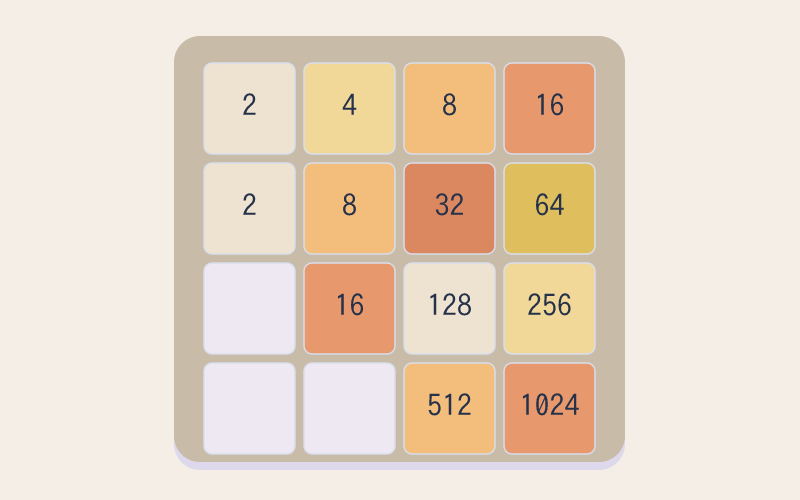
Swipe to slide every tile in one direction; equal values collide and double into the next power of two. Watch 2 become 4, 4 become 8, and each merge add the entire current value again — that is exponential growth you can feel.
The Last Doubling Adds as Much as Every Tile Before It Combined
Doubling looks gentle at the bottom of the board: 2 becomes 4, then 4 becomes 8, small steps that feel steady. What trips players up is that each merge does not add a fixed amount — it adds the entire current value again, so 512 merging into 1024 gains 512 in a single move. That is why progress that felt quick early on seems to stall near the top. The numbers make the leap concrete: every power of two from 2 up to 1024 adds to just 2046, which means one 2048 tile is worth more than all the smaller tiles you could ever hold combined. Once students expect the total to compound rather than creep upward, the late-game slowdown stops feeling like bad luck and starts looking like the shape of exponential growth.
From Repeated Doubling to Whole-Number Exponents (Grades 4-6)
Repeated doubling is a pattern before it is a rule. Fourth graders generate growing sequences like 2, 4, 8, 16 and describe how each term forms, the skill behind standard 4.OA.C.5; a year later they analyze the relationship between consecutive terms (5.OA.B.3), noticing that every step multiplies by two rather than adding a constant. That observation is exactly what exponents capture: by Grade 6 students write 8 as 2^3 and can read the 2048 tile as 2^11 (6.EE.A.1). Counting the doublings from 2 up to 2048 — ten of them — turns the game's climb into a first, tangible encounter with exponential notation.
Three Skills Practiced in 2048 Merge
- double facts with equal addends
- powers of two and repeated doubling
- managing board space with a consistent direction
Teacher and Parent Note
Before the round, have the student choose one corner for the largest tile and explain why. When they reach a new value, write it as both addition and multiplication, such as 64=32+32=2x32.