Halloween Candy: Catch Only the Subtraction Candies That Hit the Target Difference
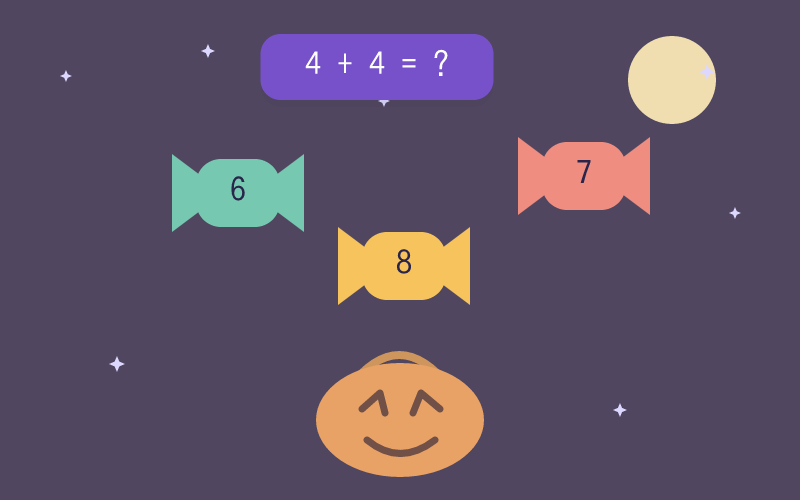
You slide a pumpkin basket left and right to intercept falling candies, each printed with a subtraction expression, and let the wrong answers drop past. Reading the target once and matching many expressions to it trains equivalent-difference thinking, not one-off arithmetic.
The Move Second Graders Miss: Push Both Numbers Up and 12−7 Turns Into 15−10
Most second graders can grind out 12−7 one candy at a time, but they never notice that nudging both numbers up by 3 turns the same subtraction into 15−10 — and 15 minus a round 10 barely needs thinking. That is constant difference: add the same amount to the top and bottom number and the gap between them never moves. In this game the target gap sits at the top while candies rain down, so the round-number candy like 15−10 becomes the anchor you check the trickier ones against. A child slides the pumpkin basket to intercept every expression that shares the gap and lets the mismatches drop past. Round after round the same difference keeps arriving dressed as 12−7, 15−10, and 8−3, so children stop re-subtracting every card and start sliding one problem onto an easier one.
From Within-20 Facts to Two-Digit Shortcuts: Where Constant Difference Starts Paying Off
The game leans on the within-20 subtraction fluency behind standard 2.OA.B.2, then points it toward the two-digit reasoning of 2.NBT.B.5, where constant difference turns an ugly problem like 62−38 into a friendly 64−40. Learning early that both numbers can slide together without changing the answer sets up third-grade work on how addition and subtraction undo each other and on judging whether an equation reads as true. Reshaping a subtraction into an easier equal one, instead of always computing it head-on, is the flexibility later multi-digit and fraction work quietly depends on.
Three Subtraction Skills Practiced While Catching Candy
- Calculate the difference of a subtraction expression.
- Recognize different expressions with the same result.
- Filter falling expressions by target value.
Three Moves to Catch Candy: Read, Subtract, Move
- Read the target difference for the round.
- Evaluate each falling subtraction expression.
- Move the pumpkin basket to catch matching expressions and review misses.
Five-Minute Teacher Routine: Use the Pumpkin Basket for Equivalent Sorting
Practice a few same-answer subtraction expressions on paper first. Once students see equivalent results side by side, the game decisions become much faster.
Halloween Candy Questions Teachers Ask About Equivalent Differences
Q: Why does my student solve every expression slowly?
A: They may not see same-result groups yet. Compare a few equivalent subtraction expressions before play.
Q: Can this review subtraction facts?
A: Yes. It is especially useful for practicing several expressions that share one target difference.