Classroom Counting Circle: Chant Skip-Count Multiples Together as a Class
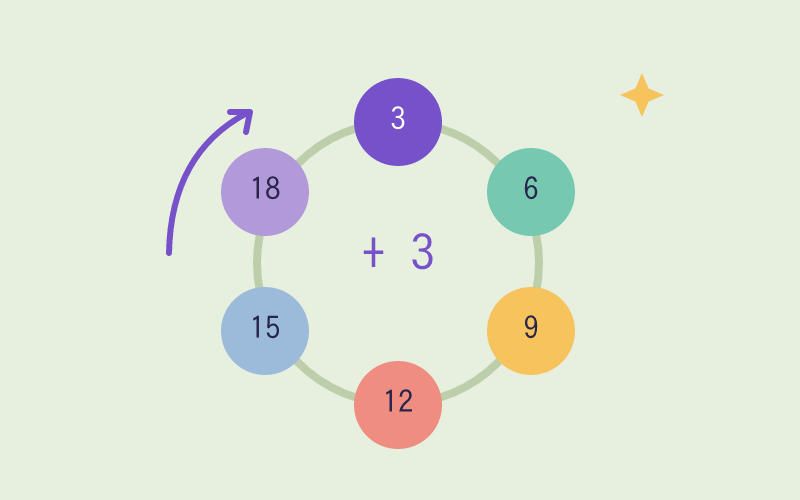
Students rotate through Sparkle, Pass & Count, or Silent Count, calling the next number in a skip-count sequence and then running it backward when the circle reverses. The circle trains working memory, attentive listening, and the sense that a counting sequence can be read forward and back.
The Turnaround: Counting Around by Twos Feels Easy Until the Circle Reverses Direction
Most children can chant two, four, six, eight around the circle without a stumble — that forward run through the two times table becomes almost automatic. The sequence falls apart the moment the circle turns and the same class has to count back by the same step from wherever it stopped. Now each player has to hold the current number, remember that the step is still two, and subtract instead of add in the instant the turn reaches them. That reversal is the real skill: a skip-count sequence has a direction, and a fluent counter can run it either way, and reversing a times table is where genuine fact fluency shows. Sparkle rotates a chosen step around the group and drops out every tenth call, so a player who freezes on the turnaround gets an immediate, audible consequence. Pass & Count and Silent Count add a listening layer, so the class rebuilds the up-then-back sequence with one voice at a time instead of leaning on the person before them.
From a Steady Forward Two-Step in First Grade to Reversing Larger Steps by Sixth
The circle starts where counting lives: first graders run a slow forward step and meet the idea that the same sequence can be walked backward. By grade two the class skip-counts by twos, fives, and tens and then reverses each one (2.NBT.A.2). Older players stretch the step into larger jumps and begin naming the pattern that repeats whether the circle moves up or down (4.OA.C.5), while the group keeps proving that a skip-count sequence is a single chain read in two directions (3.OA.A.1). It scales from a slow forward two-step in grade one to fast reversals of bigger steps by grade six.
Core Skills Practiced in Classroom Counting Circle
- generating multiples from a chosen step
- maintaining attention across rotating turns
- listening to prevent repeated or overlapping calls
Start in Three Steps
- Choose Sparkle, Pass & Count, or Silent Count.
- Set the player count and skip-count step.
- Mark correct, miss, or overlapping voices as the activity runs.
Teacher and Parent Note
Begin with a slower step and four to six players. Afterward, have the final two students recite the complete multiple sequence together.