Measurement Workshop: Read Rulers, Scales, and Vessels to Nail Every Unit
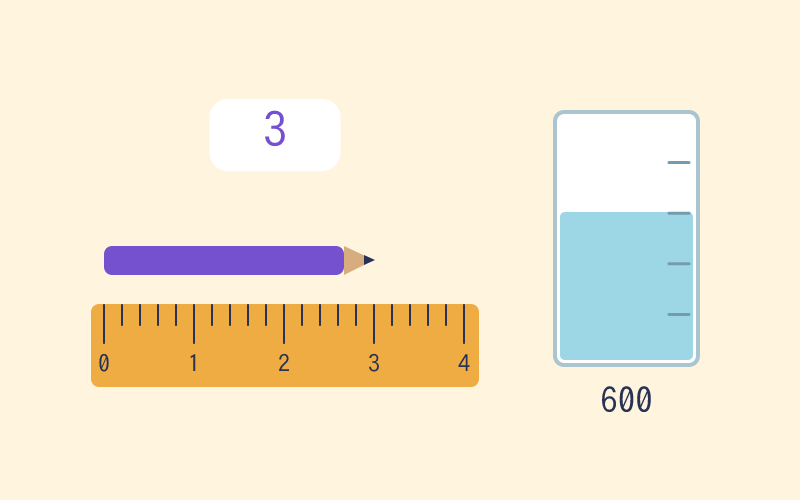
Pick metric or customary, then read a sliding ruler, a balance beam, and a graduated vessel to answer with the right number and unit. It trains the habit of reading a scale by intervals and pairing every measurement with the unit that makes it mean something.
Count the Gaps, Not the Ticks: Where Ruler and Scale Readings Break Down
Most students reach for the number printed nearest the pencil's tip and count tick marks instead of the spaces between them, so a block ending at the fifth interval gets read as six. This workshop hands you three instruments — a sliding ruler, a balance beam loaded with 1 kg weights, and a graduated vessel — and asks you to name the value together with its unit. Because the fill bar, the beam, and the pencil all move against a fixed scale you can see, the difference between a mark and an interval stops being abstract and becomes concrete spatial reasoning you can watch. Switching between metric (cm, kg, mL) and customary (in, lb, cups) then forces you to re-read the same instrument through a fresh unit lens.
Three Instruments, Grades 2–5: Ruler Reads Growing Into Unit Comparison
Second graders begin by measuring length with a ruler (2.MD.A.1), then grow into reading mass and liquid volume on labeled scales (3.MD.A.2). Fourth and fifth graders use the same balance and vessel to compare and relate metric and customary units (4.MD.A.1), the groundwork for later work with rates and decimals. Each round links a concrete instrument to the number it produces, so estimation and unit sense build side by side.
Learning Points
- visual modeling
- step checking
- units and quantity
- applied reasoning
Steps and completion rules
- Choose a measurement system and read the units and scale on the visual.
- Count ruler intervals for length, weights for mass, and the vessel level for capacity.
- Select the matching value. After three tasks, try the other system and compare its unit names.
Teacher / Parent Note
Read the value and unit together. Explain why 750 mL is three quarters of a liter rather than 750 whole liters.