Number Pairs 10: Match Every Bubble Pair That Sums to Ten
Find five pairs that add to 10 among ten numbered bubbles in 50 seconds. Even equal values must come from two different bubbles.
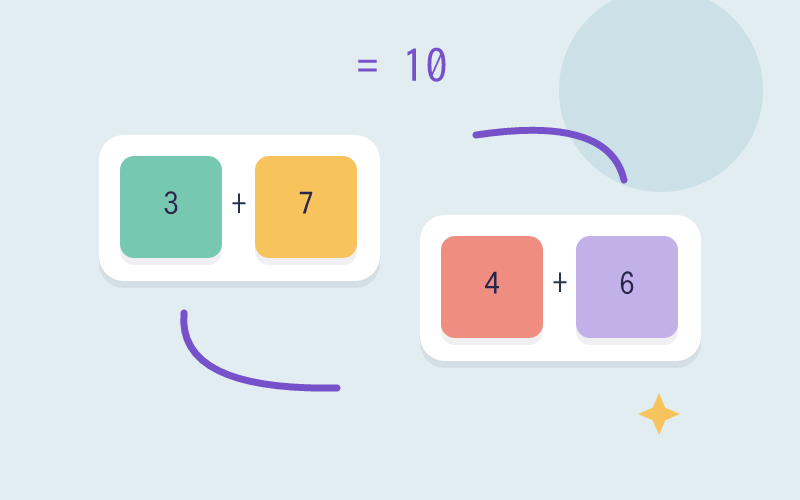
| Name | Number Pairs 10 |
|---|---|
| Catalog grade suggestions | Kindergarten, Grade 1 |
| Actual task | Find pairs totaling 10 in a timed matching activity. |
| Practice objective | Practice the following task: Find pairs totaling 10 in a timed matching activity. |
Grades are catalog suggestions. Curriculum entries are references, not certification. Choose a practice length that fits your session.
How do you find the missing partner in Number Pairs 10?
Subtract the first bubble value from 10 to find its complement. Number Pairs 10 requires two different bubbles whose values total 10.
Worked example: after selecting 4, look for 10 − 4 = 6. The pair is 4 + 6 = 10.
| Goal | Five pairs totaling 10 |
|---|---|
| Time limit | 50 seconds |
| Replay | Rearranged bubbles; the make-ten pairs stay the same |
Task and scope
Most kindergartners can count out 6+4, yet hand them a lone 8 and they slide back to finger-counting instead of asking how far it sits from ten. Number Pairs 10 forces that missing-part question onto every tap: pick one bubble, and the board silently dares you to find the partner that fills the ten-frame. Because a wrong pairing is rejected the instant you tap the second bubble, students get immediate feedback on the guess rather than a delayed worksheet mark. Replaying reshuffles the ten bubbles, so success depends on the relationship 3 pairs with 7, not on a memorized screen position. Over a few 50-second rounds the five anchor pairs stop being sums to compute and start being facts students subitize.
Check readiness and task range
Use when learners are ready to find complements to 10. The activity has a 50-second countdown; it is not an untimed number-recognition task.
Practice in this activity
- Calculate the complement: subtract the first bubble’s value from 10.
- Distinguish values from bubbles: equal values still need two different bubbles.
- Check the sum: after an incorrect choice, add the two values again before selecting another pair.
Controls and steps
- Select a numbered bubble and work out how much it needs to reach 10.
- Click a different bubble to form a pair. A correct match clears; after an incorrect match, wait for the red feedback to end and choose again.
- Find all five pairs within 50 seconds. Review the pair count at the end and choose Play again to restart.
Teaching discussion
Ask for the missing complement before the learner selects a second bubble. Use 10 − 6 = 4 as an offline demonstration.
Questions about the task
Q: Can I select the same bubble twice to make 10?
A: No. A pair requires two distinct bubbles, including when their values are equal.