Shut the Box Math: Break Every Dice Roll Into Tiles That Shut the Box
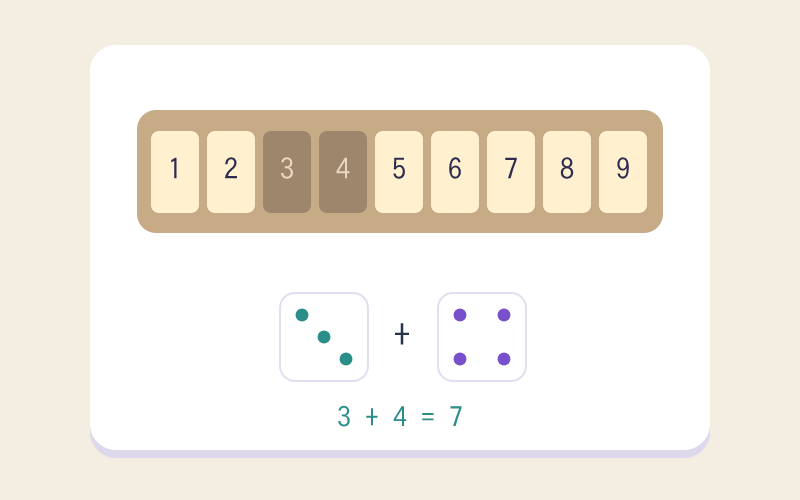
Roll two dice, read the total, then tap the open tiles 1–9 whose values add up to it. Choosing among 7, 1+6, or 2+5 for the same seven trains flexible number decomposition and a step of forward planning.
The First Combination That Works Is Rarely the One That Wins
Most players add the dice correctly, then close the first tiles that reach the total and move on. The trap is that shutting a 3 and a 4 for seven can leave you unable to answer the next roll, while shutting the single 7 keeps the small tiles free. Because every tile visibly flips down and stays down, the cost of a decomposition sits right in front of you instead of hidden in your head. Roll an eight after you have already spent the 5, and the board forces the question of what pairs remain — 6+2, or nothing. That turns 'decompose 8' from a fact to recall into a choice with consequences you can see.
Planning Two Rolls Ahead: Where Addition Fluency Turns Strategic, Grades 2–6
Younger players lean on making and breaking numbers within 20 — the decomposition work of 1.OA.C.6, joined by the within-20 fluency of 2.OA.B.2. As the box empties and totals cross into two-digit sums, the arithmetic reaches toward the 2.NBT.B.5 strategies older students formalize. The forward-looking call — spend a big tile now or save it — is an early taste of the strategic reasoning that later grades bring to probability and game theory.
Learning Points
- math fact recall
- mental strategies
- speed with accuracy
- error review
Steps and completion rules
- Add the dice and select open tiles whose values reach that total.
- Confirm the combination to close those tiles and receive the next roll.
- Continue while a combination is possible, finishing when all tiles close or no legal combination remains.
Teacher / Parent Note
For a roll of 7, compare 7, 1 + 6, and 2 + 5 and discuss the different choices left for later rolls.