Snow Ball Catch: Catch Every Snowball Numbered Above 20
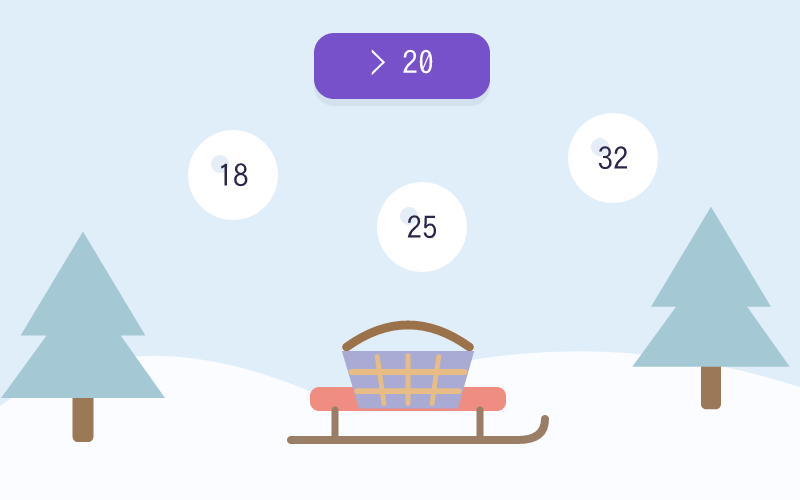
Slide a sled left and right to intercept falling snowballs, catching only the ones marked with a number greater than 20. It turns a paper 'greater than' rule into a split-second decision made under a gentle time pressure.
Why 20 Itself Belongs on the Ground, Not in the Sled
The quiet trap in 'greater than 20' is the boundary value itself: plenty of first graders read the phrase as 'twenty and up' and scoop the 20-ball without a second thought. On paper that slip hides, because there is always time to reconsider. Here the snowball keeps falling, so the child has to commit to a yes-or-no before it lands — 21 goes in the sled, 20 hits the snow. Sliding toward a chosen ball turns the comparison into a physical reach, and every distractor you let drop is instant, visible proof that the boundary is strict.
How the Fixed 20-Ball Cutoff Grows Into Grades 1-2 Number Comparison
By the time this game clicks, children can already count and order numbers to 100; catching only the balls above 20 pushes that ordering straight into comparing two- and three-digit numbers with the <, >, and = symbols. Anchoring one fixed boundary at 20 rehearses CCSS 1.NBT.B.3, where first graders compare two two-digit numbers, and sets up CCSS 2.NBT.A.4 for symbol-based comparison in second grade. The fixed cutoff keeps the load light, so the comparison itself — not a changing rule — is what gets faster.
Three Comparison Skills Practiced While Catching Snowballs
- Decide whether a number is greater than 20.
- Use 20 as a clear range boundary.
- Filter falling targets without catching distractors.
Three Moves to Catch: Read, Compare, Slide
- Read the number on each falling snowball.
- Decide whether it is greater than 20.
- Slide the sled to catch matching snowballs and avoid 20 or below.
Five-Minute Teacher Routine: Turn the Target Line Into Sorting
Sort a few examples into above-target and at-or-below-target groups before play. That quick comparison warm-up helps the digital filtering become more reliable.
Snow Ball Catch Questions Teachers Ask About Range Boundaries
Q: Why does my student catch 20?
A: They need to hear that greater than 20 does not include 20. Draw 20 as the boundary line first.
Q: How is this different from Halloween Ghost Hunt?
A: Snow Ball Catch practices one fixed range. Halloween Ghost Hunt practices changing comparison directions.