Tax Collector: Outscore the Collector by Spending Factors Wisely
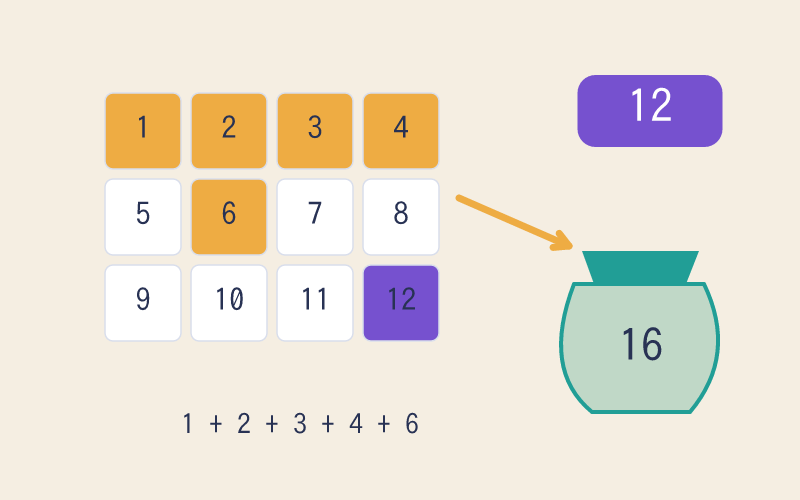
You claim one paycheck each turn while the collector sweeps up every proper factor still on the board. Legal moves shrink as numbers vanish, so each click is a small factoring decision with a delayed cost.
Grabbing the Largest Number First Can Hand Over More Than You Keep
Students who chase the highest paycheck usually forget that the collector immediately claims all of its remaining proper factors, and those factors can outweigh the paycheck itself. The game makes this visible: click 12 on the 1–12 board and watch 1, 2, 3, 4, and 6 slide to the collector — a tax of sixteen against a gain of twelve. Because a number is legal only when at least one factor is still on the board, the order in which you spend numbers decides which paychecks survive. Playing forces students into methodical casework, listing a number's proper factors through systematic counting before committing, turning abstract divisibility into a running score they can feel.
From Factor-Pair Fluency to the Casework Behind Olympiad Number Theory
The board rewards the factor-pair fluency introduced in Grade 4 (CCSS 4.OA.B.4), where students first find all factors of a whole number and label it prime or composite. Here that skill becomes a resource to spend, previewing the greatest-common-factor reasoning of Grade 6 (CCSS 6.NS.B.4) and the multi-move planning behind olympiad number theory. Learners who already list proper factors quickly advance to comparing whole tax-versus-pay totals, a natural bridge to strategic divisibility work across Grades 5–7.
Core Skills Practiced in Tax Collector
- proper factors and divisibility
- comparing immediate pay with tax cost
- predicting how one choice changes later legal moves
Start in Three Steps
- Choose the 1–12 or 1–18 board.
- Select a paycheck that still has an available factor.
- When no legal move remains, compare both totals.
Teacher and Parent Note
Before clicking, have students list the factors the collector will receive. Review one paycheck that looked valuable but created a larger tax cost.