Time Teller: Read the Analog Clock and Match the Right Time
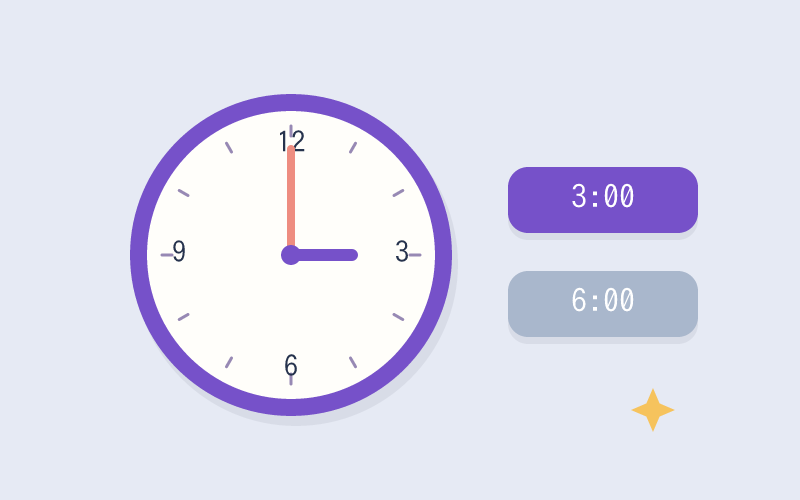
Watch the hour and minute hands on an analog clock, then tap the time card that matches. Each round trains you to separate the two hands and read minutes in five-minute steps.
The Hour Hand Doesn't Jump — It Drifts Between Two Numbers
Most Grade 1-2 readers can rattle off digital time, yet freeze the moment the short hand sits between the 6 and the 7. They assume it must point exactly at a number, so 6:30 gets read as 7:30. Time Teller keeps the analog face in view while you pick from digital time cards, so a wrong tap immediately reveals the hands you misjudged. Because the minute hand and hour hand stay side by side, you learn to read the minutes first, then decide which hour the short hand has already drifted past.
The K-3 Climb from Whole Hours to Five-Minute Reading
Clock reading climbs a tight K-3 ladder, and this arcade covers all three rungs. First graders start with the hour and half hour (1.MD.B.3); second and third graders then work up to reading to the nearest five minutes (2.MD.C.7, 3.MD.A.1). Nailing the five-minute count here sets up elapsed-time problems and a.m./p.m. reasoning later.
Three Time Skills Practiced on the Clock Face
- Distinguish the hour hand and minute hand by length and position.
- Read five-minute marks around the clock face.
- Match analog time to a digital time card instead of guessing from one hand.
Three Moves to Tell Time: Hour Hand, Minute Hand, Time Card
- Look at the shorter hour hand to decide the hour range.
- Look at the longer minute hand and count the five-minute marks.
- Combine the hour and minutes into digital time.
- Choose the time card that matches the clock face.
Five-Minute Teacher Routine: Set the Clock Before Reading It
Use a toy clock or paper clock before the game so students can set a time with their own hands. Setting first often clears up hour-hand and minute-hand confusion faster.
Analog Clock Questions Teachers Hear
Q: Why does a student read 6:30 as 7:30?
A: They may see the hour hand near 7 and ignore that it is between 6 and 7. Reading the minute hand first, then checking the hour range, helps.
Q: Should students memorize the five-minute marks?
A: Start by counting 5, 10, 15 around the clock, then let repeated rounds build recall for each number position.