Times Table Mastery: Lock In Every Fact From 2 to 12
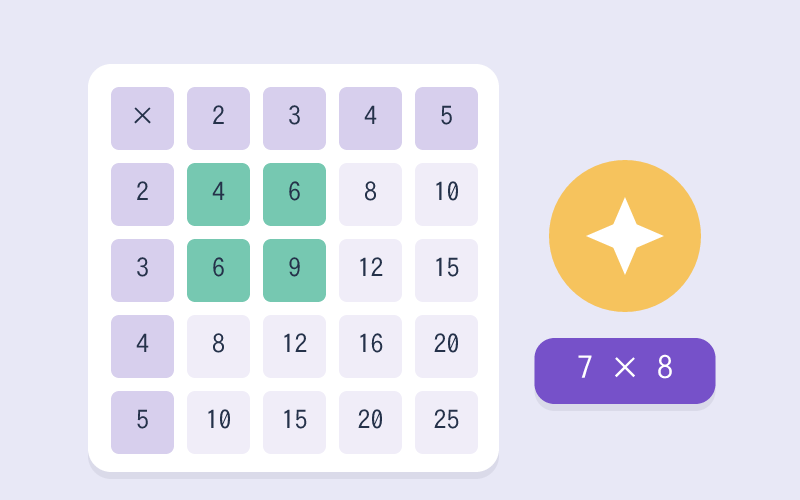
Pick the tables you want, then type each product before the timer runs out or your third miss ends the run. The engine keeps re-serving the facts you fumble, so recall shifts from counting on fingers to instant retrieval.
Your 12s Column Stays Gray While the Rest of the Grid Goes Green
Watch the mastery grid and one pattern surfaces fast: the low tables green out early, but a handful of cells — usually up the 12s column, like 12×7 — stay stubbornly gray. The grid gives every fact its own mastery state instead of treating the whole table as one block, so it can tell a fact you nail from one you only guessed at. When 12×7 comes back slow or wrong, that single cell drops in mastery and starts resurfacing far more often than the greens around it — the drill never locks onto one equation, it keeps rebalancing toward whichever cells are still weak. You pick the tables and a pressure mode — timed sprint, fixed set, or three-misses-and-out — and answer by typing the product, so there's nothing to guess your way through. Each clean answer nudges that cell greener; miss it and it comes right back until the whole grid holds its color.
An All-Green Mastery Grid Is the Runway for Multi-Digit Multiplication, Grades 2–5
This game suits Grades 2–5, where students move from the equal-group and array meanings of multiplication (3.OA.A.1) toward recalling every product through 10×10 — and on up the 12s — from memory (3.OA.C.7). A fully green grid is the runway: when a fact like 12×7 is instant, working memory is freed for multi-digit multiplication (4.NBT.B.5), where each partial product still rides on place value and regrouping, and for the long division that follows. The per-cell fluency the grid builds is what keeps later 4.OA and 5.NF work feeling manageable rather than overwhelming.
Learning Points
- math fact recall
- mental strategies
- speed with accuracy
- error review
Steps and completion rules
- Select the tables to practice and choose a session mode.
- Type each product and submit it, watching the answer feedback and current streak.
- Review missed facts and mastery cells at the end, then choose the tables that need another attempt.
Teacher / Parent Note
Ask learners to explain a fact using the reversed factors, such as 6 × 7 and 7 × 6, before pursuing speed.