Work Rate: Convert Each Worker's Time into a Daily Rate and Solve
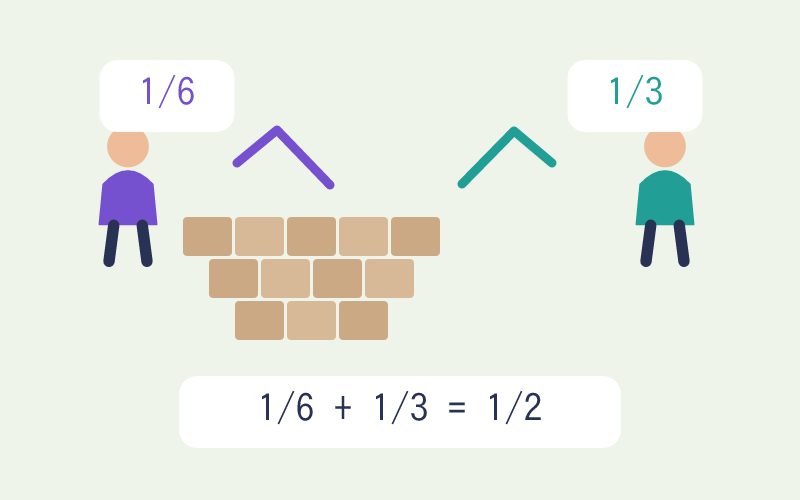
Read the worker progress bars to see how much of the job each person finishes per day, then combine those rates to pick the completion time. It trains the habit of reasoning about rate instead of raw days.
Ten Days Plus Fifteen Days Is Not Twenty-Five: Why Completion Times Refuse to Add
The trap is treating '10 days' and '15 days' as quantities you can average or add, but a completion time is not an amount of work. Here the progress bar exposes the hidden fraction: a 10-day worker fills 1/10 of the bar each day, a 15-day worker fills 1/15, and only those daily fills stack together. When a round adds prework or a worker leaving early, you watch the bar reach the point already finished and see exactly how much job remains. That visible remainder is the thing students otherwise lose track of in symbol-only setups. Seeing the bars fill turns the abstract 'combined rate' into growth you can literally point to.
From Fraction Fluency to Combined-Rate Reasoning (Grades 5-6)
Learners arrive here already able to add unlike fractions (5.NF.A.1) and read a unit rate (6.RP.A.2). Merging 1/10 and 1/15 of a job per day is exactly the ratio-and-rate thinking of 6.RP.A.3, while the prework and leave-early rounds add light casework that points toward the algebraic 'work = rate × time' equations of pre-algebra. In Chinese classrooms it is a core multi-step word-problem type on the 小升初 track.
Three Rate Skills Practiced with Progress Bars
- Convert solo completion time into a daily work rate.
- Combine rates by adding the fractions of the job completed each day.
- Handle staged work by calculating completed and remaining job amounts.
Three Moves to Solve: Write Rates, Add Rates, Divide Work
- Convert each worker’s solo time into work done per day.
- Add rates when workers cooperate.
- For prework or leave-early problems, calculate completed work and remaining work first.
- Divide the remaining work by the relevant rate and choose the time.
Five-Minute Teacher Routine: Say the Daily Rate First
Before any formula, require students to say “A does 1/a per day, B does 1/b per day.” Once rate language is clear, combined work becomes manageable.
Work Rate Questions Teachers Hear
Q: Why can’t students average 10 days and 20 days?
A: Time is not rate. The 10-day worker completes 1/10 of the job per day, and the 20-day worker completes 1/20 per day. Rates are what combine.
Q: How do prework problems work?
A: Find how much was completed before cooperation begins, subtract it from 1 whole job, then finish the remaining part with the combined rate.