Function Machine: Infer the Hidden Rule and Fill Every Output Slot
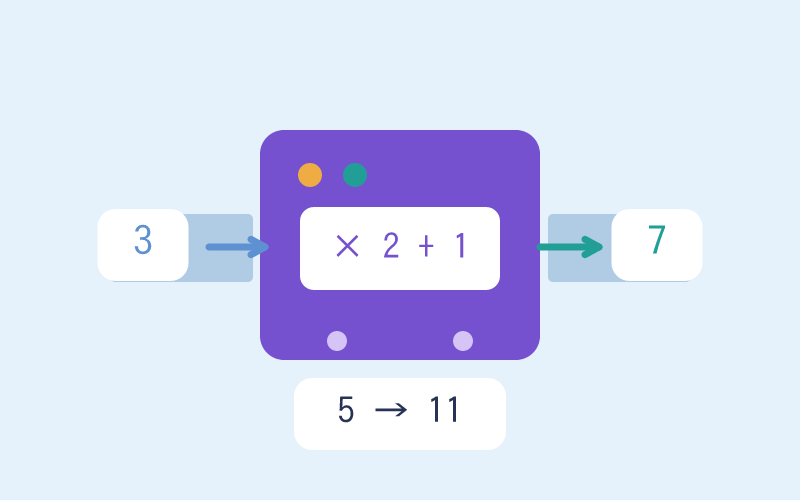
Feed numbers through the machine, read the input-output table, and figure out the single rule behind it. Each round trains you to describe a transformation as a reusable rule, not just crunch one answer at a time.
One Matching Row Can Fool You: The Rule Has to Survive the Whole Table
Grade 6 students usually stall the moment a guessed rule works for the first row and they stop checking. Function Machine fights that habit by stacking several input-output pairs in one table, so a rule like "add 4" visibly collapses when the next row multiplies instead. As you tap a candidate rule and drop the result into the missing output slot, the machine either lights the whole column green or flags the row that breaks. That instant, row-by-row feedback turns an abstract "find the pattern" into a concrete test you can watch pass or fail. Naming "multiply by 3, then subtract 1" out loud becomes the real win, not the arithmetic.
Grade 6 Standards Turn Table Patterns into Function Language
CCSS 6.EE.C.9 is the exact home for this game: students use variables to represent how two quantities change together and read those relationships from a table. It leans on earlier evaluation skills from 6.EE.A.2 and the numeric-pattern work of 5.OA.B.3, then points forward to writing linear equations and graphing functions in 8.F.A.1. Describing each machine as a rule is the bridge from spotting patterns to writing expressions.
Three Algebra Skills Practiced While Debugging the Machine
- Compare multiple input-output pairs instead of focusing on one number.
- Describe the machine rule in reusable language such as “multiply by 3, then subtract 1.”
- Predict the missing output slot and verify that the rule still fits the full table.
Steps and completion rules
- Compare all three known input-output pairs and find a rule that explains every row.
- Apply that rule to the fourth input and enter its missing integer output.
- Recheck signs and operations after an incorrect attempt. Read the revealed rule after a correct answer and continue through twelve puzzles.
Five-Minute Teacher Routine: Let Students Build a Machine
For example, 2 → 7, 4 → 11, and 6 → 15 fit 2x + 3, giving 19 for input 8. Do not rely on one pair alone.
Function Machine Questions Teachers Hear About Rules
Q: Why can my student calculate outputs but not name the rule?
A: The student may still be treating each row as a separate problem. Ask for a sentence such as “the machine doubles the input and adds 1.” Naming the rule is the algebra skill.
Q: What if a guessed rule fits one row?
A: It must fit every row. Encourage students to test their rule across the full input table before filling the output slot.