What’s My Rule? Uncover the Hidden Number Rule from Yes-or-No Clues
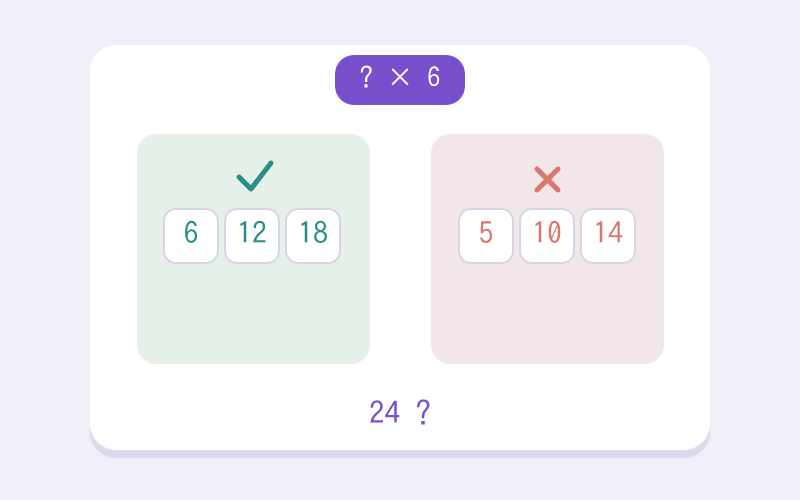
Feed whole numbers into a secret filter, watch each one come back accepted or rejected, and narrow five candidate rules down to the single one that fits. It trains hypothesis testing, the habit of hunting counterexamples, and reasoning about factors, parity, and digit patterns.
A Single Accepted Number Fits Many Rules; Only a Sharp Counterexample Rules One Out
The number 12 comes back “yes,” and that green light feels like proof — so players keep feeding in look-alikes such as 14 and 18 and gather no new information. The catch is that 12 clears both “even” and “multiple of three” at once, so every other even number only echoes what is already known. Because the filter answers each submission with nothing but yes or no, the way forward is to engineer a probe that two surviving candidates disagree about, then watch which rule the answer eliminates. Swapping in 9 splits that ambiguous “yes” apart: a “yes” throws out “even,” a “no” throws out “multiple of three.” The on-screen columns of accepted and rejected numbers make that deduction concrete, pushing players from collecting confirmations to designing counterexamples.
From Grade 4 Factors to Grade 8 Function Rules, Where Deductive Reasoning Takes Root
The game rests on Grade 4 factor and multiple work (4.OA.B.4) — recognizing primes, composites, and cases like “exactly four factors” — and on extending a numerical sequence, then stating the rule behind it (4.OA.C.5). From there it stretches to Grade 6 factor and divisibility reasoning (6.NS.B.4) and the mathematical practice of constructing and defending arguments from evidence (MP3). That progression prepares older students for the input-output rule thinking that underpins functions in Grade 8.
Core Skills Practiced in What’s My Rule?
- testing examples against a condition
- choosing counterexamples that separate candidates
- expressing rules with factors, multiples, and digit features
Start in Three Steps
- Submit a test number from 1–200.
- Record accepted examples and rejected counterexamples.
- After three probes, choose and explain the rule.
Teacher and Parent Note
Encourage probes that separate two candidate rules instead of testing consecutive values. After a guess, ask for one new example and one counterexample.