Nonogram Pixel Logic: Turn Number Clues Into Hidden Pixel Art
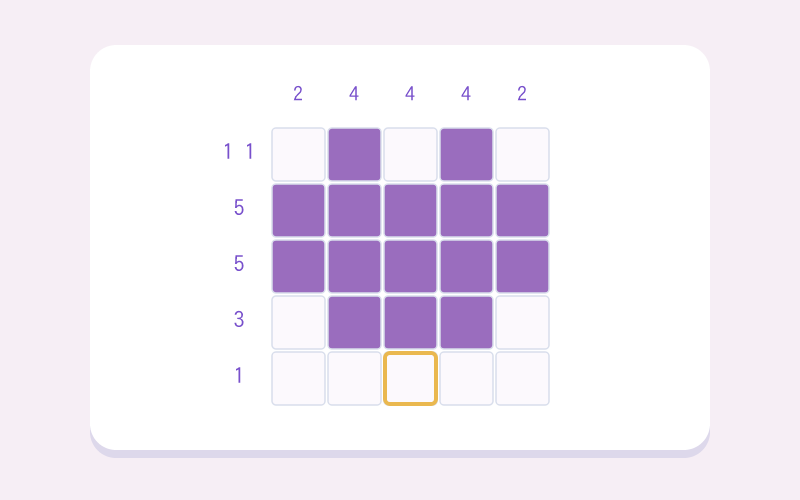
Fill, cross, and clear cells as you read each row and column clue, building a black-and-white picture one block at a time. Every move trains you to hold several constraints in mind and commit only to what the clues force.
Where a Clue Overlaps Itself: Forced Cells Before You Know the Start
Most students freeze when a clue like 4 sits in an eight-cell row: no single starting spot is certain yet, so they guess. The turning point is realizing that a run of 4 in a row of 8 must cover the middle cells no matter where it begins — that overlap is guaranteed. Filling those forced cells first, then crossing what a row clue rules out, shrinks the choices for every crossing column. Because the board updates the instant you fill or cross, you watch one row's certainty tighten a column's clue and vice versa. The picture emerges from deduction, not from coloring pixels you hoped were right.
Spatial Logic and Deductive Reasoning for Grades 3–7
This puzzle grows the reasoning that MP7 and MP8 describe: solvers who can already count lengths and read a grid learn to look for repeating structure and use regularity to justify each fill. From here the same deduce-and-eliminate habit transfers to constraint puzzles like Kakuro and to algebraic reasoning where several conditions must hold at once (MP1).
Four Math and Logic Skills Practiced in Nonogram
- translate number clues into consecutive block lengths
- cross-check row limits against column limits
- mark cells that must remain empty
- combine local overlaps into a complete pixel picture
Four Steps to Complete a Nonogram
- Start with a large clue or a line with very few placements.
- Fill cells that must belong to the picture.
- Cross cells that must stay empty to constrain other clues.
- Use Check to review current marks and continue until all row and column clues agree.
Teacher and Parent Note
Ask the student to explain a clue such as 3, 1: how long each block is and why one empty cell must separate them. When they get stuck, ask which line has the greatest overlap instead of naming a cell.
Play and rules
Each row and column clue describes consecutive filled blocks. Switch between Fill, Cross, and Clear and use intersections of row and column clues to reveal the picture.
Modes and difficulty
Daily mode keeps the same puzzle for the date, while Practice provides another. The 5×5, 10×10, and 15×15 boards increase the number of cells and the amount of multi-block reasoning.
Practice connections
A clue such as 2, 1 means a block of two, at least one empty cell, then a block of one. Compare the possible placements and mark only cells shared by every remaining arrangement.