Minesweeper Number Logic: Deduce Every Safe Cell on a No-Guess 6x6 Board
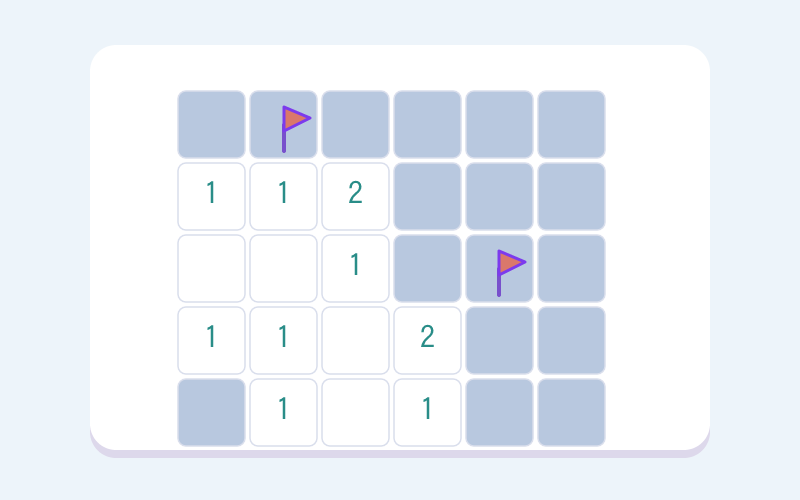
Read the revealed numbers, flag the mines you can prove, and click open the cells you know are safe. Each move trains constraint reasoning over overlapping neighbor counts instead of luck.
One Number Is Rarely Enough: The Answer Hides Where Two Clues Overlap
Most players stall by reading a single number and guessing which neighbor hides its mine — a 2 never points to a specific cell, only to a count spread across up to eight of them. The board breaks that habit by forcing you to lay one clue's neighborhood over another's and watch where the overlap makes a cell provably safe or mined. Placing a flag pins a proven mine on the screen, so the next number can spend that fact immediately instead of asking you to re-derive it. When flags already equal a clue, every other covered neighbor opens as safe; when covered cells equal the mines still missing, all of them get flagged. Because the 6x6 grid is hand-checked to need no guess, a stuck moment always means a certain clue is waiting elsewhere, not that the board is unfair.
From Neighbor Counting to Multi-Constraint Deduction Across Grades 3-8
Grade 3 players begin by naming which cells a single clue controls, building the neighbor-counting and set-membership sense behind CCSS MP.7 (using structure). By Grades 6-8 the same board asks for a full argument — mines flagged, covered neighbors, mines still required — which is the viable-reasoning work of CCSS MP.3 and the persistence of MP.1. The skill it feeds forward is conditional elimination: holding several linked constraints at once, the groundwork for later algebraic systems and proof.
Four Reasoning Skills Practiced in Minesweeper for Kids
- translate a number into a mine-count constraint over neighboring cells
- cross-check overlapping clues to identify cells that must be safe or mined
- record a conclusion with a flag instead of holding every fact in memory
- pause an uncertain area and move to a clue that supports a definite deduction
Four Steps to Solve the No-Guess Board
- Start from an open number and count its still-covered neighboring cells.
- When its flags already equal the clue, reveal the other covered neighbors as safe.
- When its covered-neighbor count equals the mines still required, flag those cells.
- Cross-check each newly opened clue and continue until every safe cell is revealed.
Teacher and Parent Note
Replace “Where do you think the mine is?” with “How many mines are still missing, and how many covered cells remain?” Ask for one complete deduction before every click. During review, choose a cell fixed by two overlapping clues and have the student draw both neighborhoods.
Minesweeper for Kids Questions
Q: What does a 2 mean?
A: Exactly two mines sit among the surrounding cells. It does not mean the second cell is a mine or that the whole row contains two mines.
Q: Do I need to guess on this board?
A: No. Leave an uncertain area for later and find a clue whose flags are complete or whose covered cells equal its remaining mine count.
Q: Why use flags?
A: A flag keeps a proven mine visible so every neighboring clue can immediately use that fact in the next elimination.