Binary Grid: Deduce Every 0 and 1 Without a Single Guess
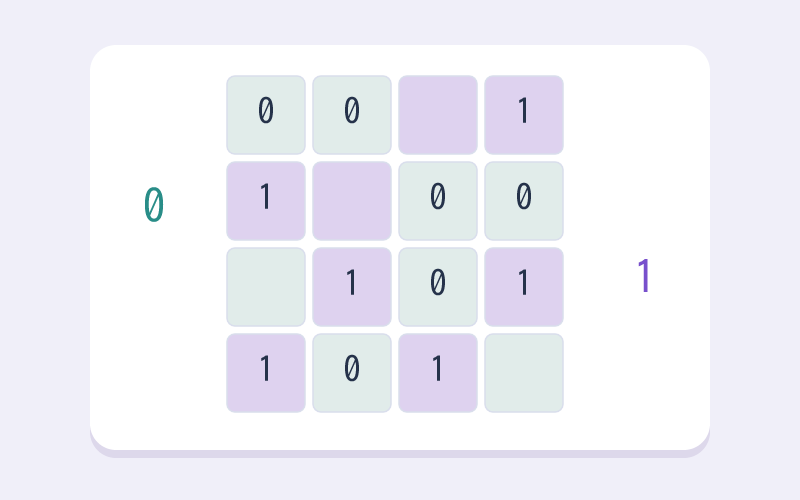
Tap empty cells to place 0 or 1 while the board flags conflicts the instant they appear. Each move trains you to hold three constraints at once and reason from what the grid already forces.
A Digit That Perfects the Row Wrecks the Column, Because Each Cell Answers to Both
Most players lock in a value because it balances the row in front of them, then find it forces a third identical neighbor two columns over. That two-directional pressure is where the puzzle bites: every cell answers to its row, its column, and the ban on three consecutive twins. Because you tap one cell and the conflict flag lights up immediately, the abstract rule becomes a visible signal you can test and reverse on the spot. Start where two equal neighbors already sit and let the forced cell reveal the next one. The no-duplicate-line rule then closes the last gaps you could otherwise fill either way.
Grades 4–8: Reasoning From Constraints, Not Recall
Binary Grid bridges two stages: the fourth-grade pattern work of 4.OA.C.5 on one side, and the structural reasoning that later powers algebra on the other. Students therefore deduce from rules rather than recall facts. It leans hardest on the practice standards it demands—reading a problem for what it forces (MP.1), exploiting structure (MP.7), and defending each placement by naming the contradiction it avoids (MP.3). Those habits carry straight into solving equations and proof-style arguments later on.
Learning Points
- logical elimination
- candidate tracking
- row and column constraints
- pattern validation
Steps and completion rules
- Start near two equal neighbors or a row with only a few empty cells.
- Select a cell, enter 0 or 1, and inspect any conflict feedback.
- Check completed rows and columns for duplicates as well as balanced counts and consecutive triples.
Teacher / Parent Note
Ask for a concrete contradiction, such as the place where choosing 1 would create three consecutive ones.