Line-of-Sight Sums: Swap Tiles Until Every Sight Line Adds Up
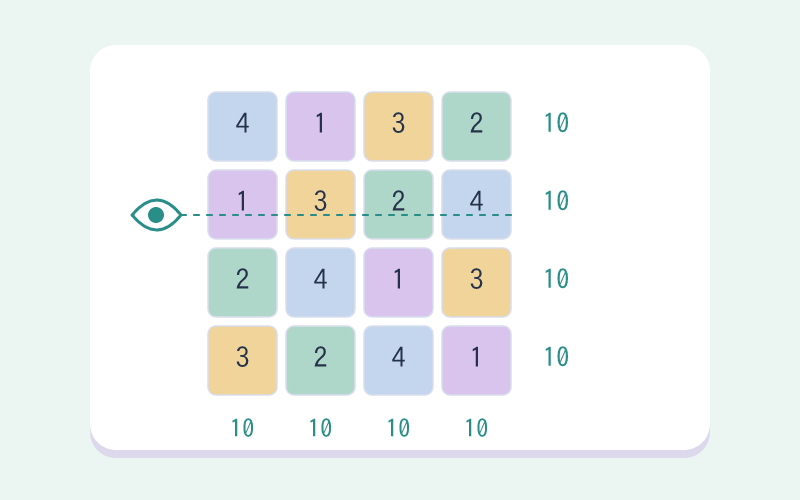
Read each row and column from its arrow, stopping at the first blocker, then swap two tiles to make every visible total match its goal. It builds order-aware addition and the habit of checking what a rule actually counts.
The Blocker Ends the Line: Tiles Behind It Never Count
Most students total every number in a row and wonder why the target refuses to match. The rule here is visibility: you add along the arrow only until you reach a blocker tile, count that blocker, then stop—anything behind it stays invisible to the sum. Because you swap tiles instead of typing answers, each move instantly reshows the four line totals, so a wrong guess shows up on the board rather than hiding in scratch work. Watching one swap change two intersecting totals forces the question 'which lines does this tile actually sit on?' That is precisely the reasoning the puzzle trains.
Where Multi-Digit Addition Turns into Constraint Reasoning (Grades 4–7)
Players arrive fluent in multi-digit addition (4.NBT.B.4) and here apply it under constraints, holding several row and column conditions true at the same time. That constraint-satisfaction habit is the on-ramp to writing and reasoning about expressions and equivalent expressions (6.EE.B.5, 6.EE.B.6). It also sharpens the awareness that a total depends on what is included, not merely on which digits are present.
Learning Points
- spatial transformation
- multi-step planning
- working memory
- strategy review
Steps and completion rules
- Read from each arrow and locate the first blocker on that line.
- Calculate the current visible sum, then select two tiles to swap.
- Track changes to row and column targets until every sight sum matches.
Teacher / Parent Note
Predict which sight lines will change before swapping, and explicitly exclude numbers hidden behind a blocker.