Dots and Boxes: Claim Edges and Win the Longest Chain
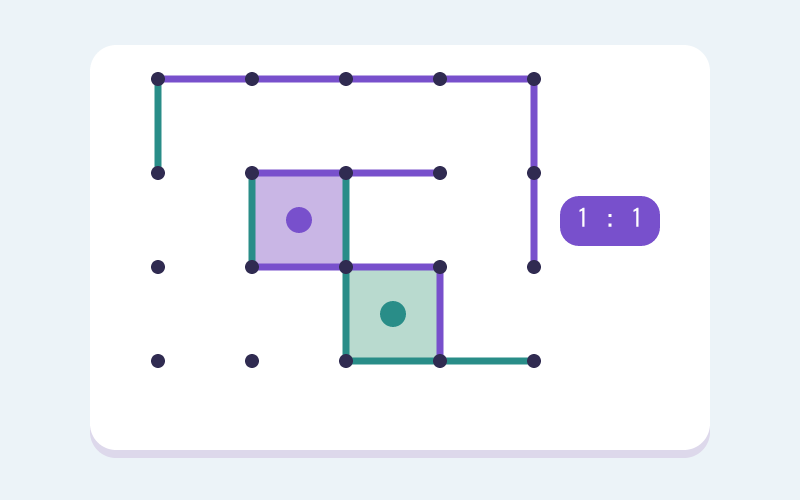
Take turns drawing single edges on a dot grid; completing a box earns another move. The real challenge is knowing when to give one box away so you can claim the long chain later.
Hand Over 2 Boxes Now to Steal the 6-Box Chain: How Parity Rules the Endgame
Most beginners close a box the instant three sides are drawn, then hand their opponent a runaway chain and lose. The turn-passing rule makes the abstract idea of tempo physical: draw a scoring edge and you move again, draw a neutral one and control flips to the other player. Watching one edge shut two boxes at once shows exactly why the third side of any square is dangerous to hand over. As the grid fills, students start counting the boxes left and reading chain parity instead of reacting one move at a time. The double-cross sacrifice — declining a chain's last two boxes to keep control — is where a guessing game turns into a deliberate plan.
From Parity Counting in Grade 2 to Chain Sacrifice by Grade 8
Younger players in Grades 2-3 first meet edges, vertices, and squares and count completed boxes using odd/even parity (2.OA.C.3). Older students in Grades 4-8 extend that into chain-length parity arguments and the double-cross sacrifice, exercising the reasoning habits behind MP1, MP3, and MP7.
Four Math Strategy Skills Practiced in Dots and Boxes
- track the one or two boxes adjacent to an edge
- compare safe edges with risky third sides
- estimate chain length and remaining-box parity
- trade a local point for control of the final chain
Four Steps to Play Dots and Boxes
- Choose local two-player or computer mode and a board size.
- Claim one open edge on your turn.
- Complete one or two boxes to score and move again.
- Compare scores after every box is owned.
Teacher and Parent Note
Before each move, ask how many boxes share that edge and mark boxes that already have three sides. During review, compare taking one immediate box with avoiding a long chain giveaway.
Play and rules
Claim one open edge at a time. Completing a square scores a point and grants another move. Before selecting an edge, look for a third side that could let the other player begin a chain of boxes.
Modes and difficulty
Choose 3×3, 4×4, or 5×5 boxes. Share one device with another player or select an Easy, Strategic, or Expert computer opponent.
Practice connections
Count the boxes in a chain before opening it. Compare taking an immediate point with keeping a safe edge available for a later turn.