Mancala: Sow Stones and Plan Captures to Fill Your Store
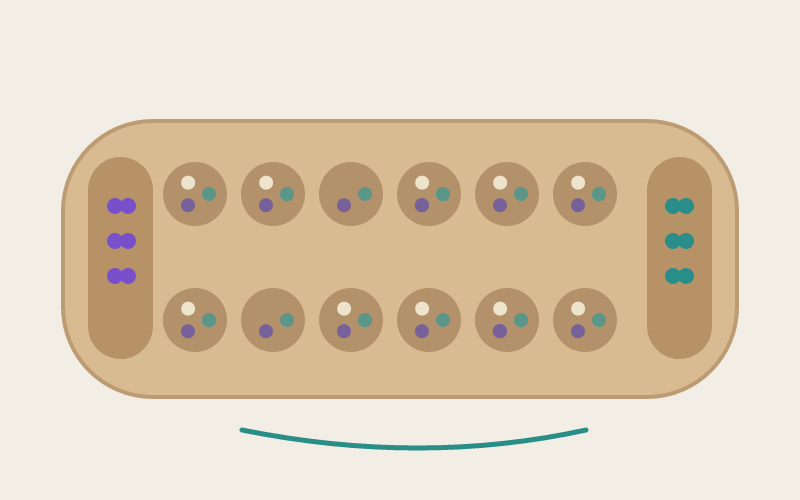
Pick a pit, sow its stones one by one around the board, and chase the extra turn or capture. Each choice trains you to count ahead and weigh a quick gain against long-term control of the board.
Where Your Final Stone Lands Decides the Turn, Not How Many You Emptied
Beginners tend to grab the pit with the most stones and drop them without tracking where the final one settles. That habit misses the whole game, because only that ending stone decides an extra turn or a capture. Here you tap a pit and watch one stone fall into each hole counter-clockwise, so you can deduce where the final stone lands as the count from your choice to the landing pit becomes visible instead of abstract. Once students see a sown stone reach the store, or drop into an empty pit facing a full one, the rules for bonus turns and captures stop feeling arbitrary and start looking like arithmetic they can predict.
Every Sown Bean Links Grade 2 Skip-Counting to Eight-Move Capture Plans
A four-pit starter board with three stones each leans on the one-to-one counting and skip-counting mastered in Grade 2 (2.NBT.A.2, 2.OA.B.2). The classic six-pit Kalah stretches that counting into multi-step turns that reward planning several moves ahead — exactly the arithmetic reasoning 4.OA.A.3 names, paired with the persistence MP.1 asks for. Older players start probing remainder and multiple structure as they work out which pit count lands its final bean squarely in the store.
Four Math Skills Practiced in Kalah Mancala
- count and distribute stones one-to-one in a fixed direction
- predict the final landing place and an extra turn
- use opposite-pit symmetry to calculate captures
- compare immediate store gain with control of later moves
Four Steps to Play Kalah
- Choose one non-empty pit on your side.
- Sow counter-clockwise through your store while skipping the opponent store.
- Use store landings for extra turns and empty-side landings for captures.
- When one side empties, collect the remainder and compare stores.
Teacher and Parent Note
Ask the student to predict the final landing place before touching the stones, then sow to verify. During review, explain how one extra turn or capture changed the distribution total.
Play and rules
This game uses Kalah rules. Choose a non-empty pit on your side and sow stones counter-clockwise, including your own store and skipping the opponent’s store. The last stone determines whether you get another turn or a capture.
Modes and difficulty
Choose a short four-pit board, classic six-pit Kalah, or a longer six-pit game. Play with another person on the same device or against one of three computer levels.
Practice connections
Before moving, count where the last stone will land. A landing in your store gives another turn; a landing in your own empty pit can capture stones opposite it.