Equation Deck Quest: Isolate x by Playing the Same Card on Both Sides
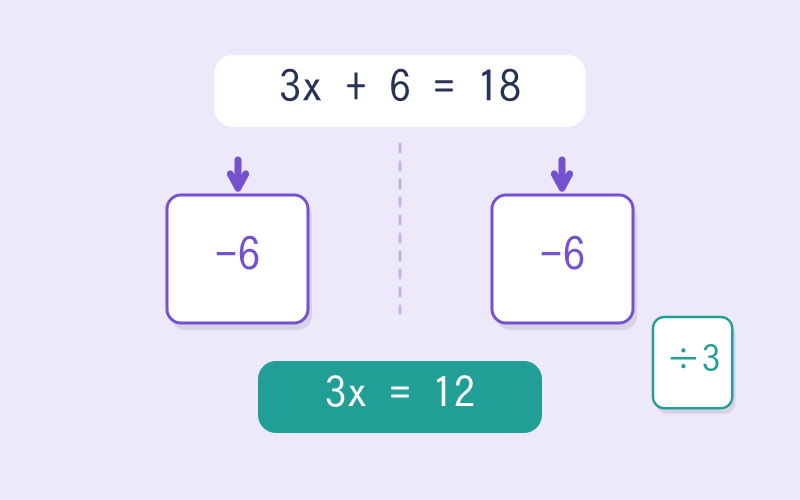
Each card fires one inverse operation onto both sides of the equation at once, and the page logs the new equivalent equation. You plan a card route that strips x bare before your move budget runs dry, training equation structure and inverse-operation reasoning.
Dividing Only the x-Side Quietly Rips the Equation in Half
When a card reads ÷2, students happily shrink 2x down to x but leave the number on the far side untouched, and the equation silently stops being true. Equation Deck Quest never lets that slip through: play a divide-by-2 card on 2x = 8 and it fires the ÷2 onto both sides at once, logging x = 4 as the next equivalent line. Because every card is a whole-equation operation and your move budget is capped, you start asking "which single inverse lands cleanly on both sides?" before spending one — clearing the constant off 2x + 6 = 14 first so the divide arrives at a tidy 2x = 8. The closing no-card challenge then hands you a raw equation with no deck at all, so you have to name and write those same both-side operations yourself.
Grades 6-8: Scaling One Both-Side Card Up to x on Both Sides
The deck assumes students can already build and read algebraic expressions (6.EE.A.2). It starts where a single both-side card finishes the job — one-step isolation like 2x = 8 becoming x = 4 (6.EE.B.7) — then stacks a subtract-then-divide card pair for two-step, bracket, and fraction equations (7.EE.B.4), and closes with linear equations that carry x on both sides, where each card must first clear a variable term off one side (8.EE.C.7).
Four Algebra Moves Practiced With Equation Cards
- Read an equation structure and decide which layer of operations should be undone first.
- Choose inverse operations and apply the same change to both sides of the equation.
- Track the equivalent-equation history and check that every card keeps the route valid.
- Apply the card strategy in the final challenge by solving an equation without cards and explaining the route.
Four Steps: Read, Play, Explain, Final Challenge
- Read the balanced equation and move budget, then identify the operation that needs to be undone.
- Choose an inverse-operation card. The card changes both sides, and the history records the new equivalent equation.
- Isolate x before the move budget ends and, when required, select the explanation that matches the route.
- After all levels, enter the exact value of x for the no-card final challenge and explain the inverse-operation strategy.
Teacher Use: Debrief the Card Route, Then Use the Final Challenge
During Equation Deck Quest, ask students to name what each card does to both sides before playing it. After each level, compare the equivalent-equation history with a shorter route. Then use the mandatory no-card final challenge to discuss whether students can turn the card actions into an independent equation-solving explanation.
Play and rules
Choose inverse-operation cards that apply the same change to both sides of an equation. The game records the equivalent equations as you try to isolate x within the move budget.
Modes and difficulty
Select Grade 6, 7, or 8. Earlier sets emphasize one-step and two-step equations; later sets introduce brackets, fractions, and variables on both sides.
Practice connections
The final challenge removes the card hand. Enter the exact value of x and explain the inverse-operation route in your own words.