Daily Equation Decoder: Crack the Hidden Equation in Six Guesses
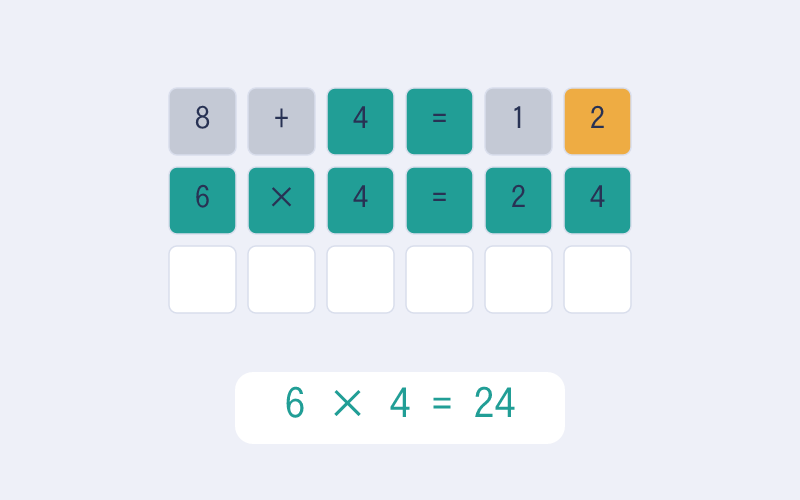
Type equations built from digits, operators, and an equals sign, then read the cell-by-cell color feedback to narrow down the answer. Every round trains deductive reasoning alongside arithmetic fluency and order of operations.
You Can Get the Arithmetic Right and Still Put the Operator in the Wrong Cell
Students learn fast that typing an equation which actually balances is the easy half; the harder half is landing the operator in the exact column the target uses. Suppose you submit 12+3=15. It evaluates correctly, yet the plus tile comes back yellow—the sign does belong in the answer, just not in that cell. The hidden equation is 1+23=24, where the same plus sits one column to the left. That single yellow operator forces two rules at once: the arithmetic must stay true, and every sign has to occupy the slot the target reserves for it. After each guess the row repaints in three colors—character-and-cell correct, character present but misplaced, or absent—so you rebuild a guess that still evaluates correctly while nudging each operator toward the column its color demands, closing in on the one equation that satisfies both.
Reading an Equation as a Structure of Operators and Values (Grades 4–7)
Because every submission is a full, balanced equation, players rehearse Grade 5 order-of-operations evaluation (5.OA.A.1) on each row, then confront the idea that an equation is true only for the particular arrangement the target holds (6.EE.B.5). Deciding where a misplaced operator must move—and re-checking that the digits around it still balance—is exactly the substitute-and-check reasoning that underpins solving one-variable equations in Grade 7 (7.EE.B.4). The puzzle turns operator placement into a bridge from computational fluency to the structure of algebraic equations.
Learning Points
- logical elimination
- candidate tracking
- row and column constraints
- pattern validation
Steps and completion rules
- Read the required length and enter a guess using digits, operators, and an equals sign.
- Submit and inspect feedback cell by cell, retaining exact positions and reconsidering the others.
- Match the complete target within six attempts, or replay and try a different practice puzzle.
Teacher / Parent Note
Translate feedback into position constraints and discuss both arithmetic validity and matching the particular target.