Number Bridges: Build One Connected Web of Islands
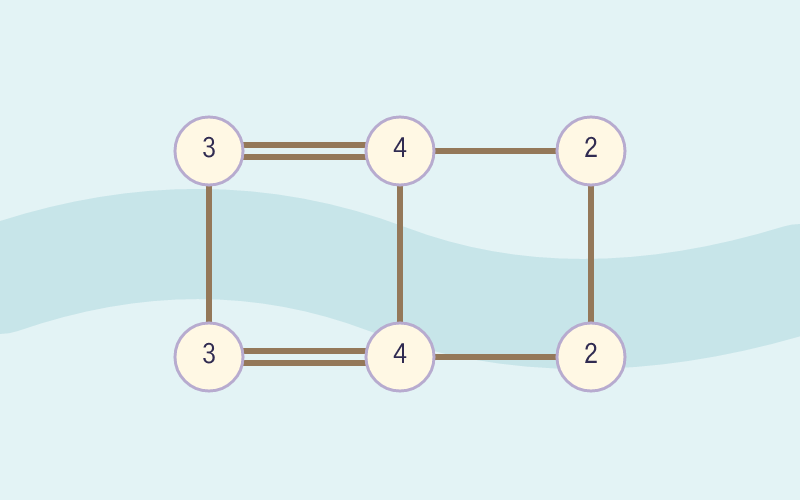
Tap the span between two islands to add or remove bridges until every number is satisfied and the whole map links up. It trains careful, constraint-by-constraint logic and the patience to test one idea at a time.
Correct Counts, Broken Graph: The Trap of the Isolated Island
Most players get every island's number to match, assume the puzzle is done, and then spot a small cluster floating apart from the rest. That single connectivity rule is where the real reasoning lives. Because each click cycles a span through zero, one, and two bridges, you can float a hypothesis, watch both endpoint totals update, and infer which links are actually forced. Corner islands with few neighbors hand you the first deductions, and from there you reason outward, always asking whether a locally correct group has quietly cut itself off. The last bridge is rarely about a count. It is the one that stitches two separate clusters into a single connected graph.
Weighing Competing Conditions: A Grade 4–8 Reasoning Stretch
Number Bridges sits after students add small sums fluently (3.OA, 4.NBT) and are ready to juggle competing conditions instead of one rule at a time. It grows the deductive habits the MP standards prize — interpreting a tangled setup (MP.1), building an argument from forced moves (MP.3), and reading structure to shortcut work (MP.7). Those same moves later power systems of constraints and the graph thinking students meet across middle-school math.
Learning Points
- logical elimination
- candidate tracking
- row and column constraints
- pattern validation
Steps and completion rules
- Inspect corner islands or islands with few possible neighbors and count their required bridges.
- Click connections to adjust bridge counts, watching both endpoint totals.
- Remove crossings and isolated groups so every island count is satisfied in one connected network.
Teacher / Parent Note
Discuss the risk of locally correct counts forming disconnected groups, and explain the purpose of the final connecting bridge.