Number Code: Crack a Three-Digit Secret in Eight Guesses
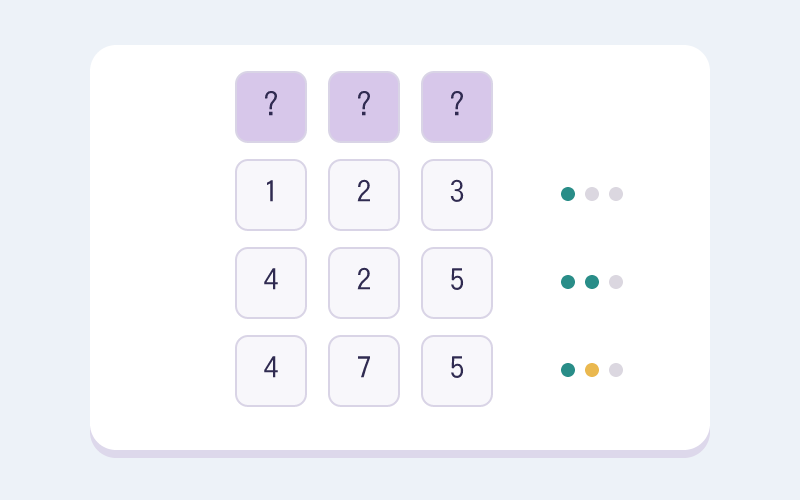
Enter three different digits and read the bull-and-cow tally each guess returns: a bull is a digit in its correct seat, a cow a digit that belongs but sits elsewhere. Every guess trains deductive reasoning and the habit of combining counts across rows instead of tweaking one digit at a time.
‘Two Bulls, One Cow’ Never Says Which Digit Earned Which
Each guess comes back as a tally — for example one bull (right digit, right seat) and one cow (right digit, wrong seat) — but the score never says which digit is the bull. Players who read the count and just reshuffle their three digits throw the information away. The power move is to compare tallies across rows. If 1-2-3 returns one bull and one cow while 4-5-6 returns none, you have proved two of the three secret digits live in {1,2,3}, the third hides in {0,7,8,9}, and exactly one matched digit already sits in its correct seat. Keeping every row on screen turns the running bull-and-cow count into a chain of place-value deductions. The eight-guess limit rewards a probe built to shift the tally in a readable way, not a random reshuffle.
Place-Value Deduction From Bull-and-Cow Counts, Grades 3–6
Number Code builds on the place-value fluency students bring from Grade 3, where 3.OA.D.8 asks them to use constraints to pin down an unknown, and carries it toward the structured argument work of Grades 4–6. Reading a bull-and-cow tally and arguing which digit must occupy which seat exercises the pattern-rule reasoning CCSS 4.OA.C.5 names outright, alongside the construct-and-defend-a-claim habit of MP.3. Moving from ‘two of these digits are in the code’ to ‘therefore this one belongs in seat two’ is early proof reasoning that later underpins algebraic thinking.
Core Skills Practiced in Number Code
- digit membership and position matching
- combining evidence across several guesses
- planning informative guesses within a limit
Start in Three Steps
- Build a guess from three different digits.
- Read exact, elsewhere, or no-match feedback.
- Revise positions and digits to solve within eight guesses.
Teacher and Parent Note
Ask students to state which digits stay and which positions change before submitting again. A reasoned revision shows more learning than random replacement.