Math Bingo: Different Form on the Card, Same Number to Cover
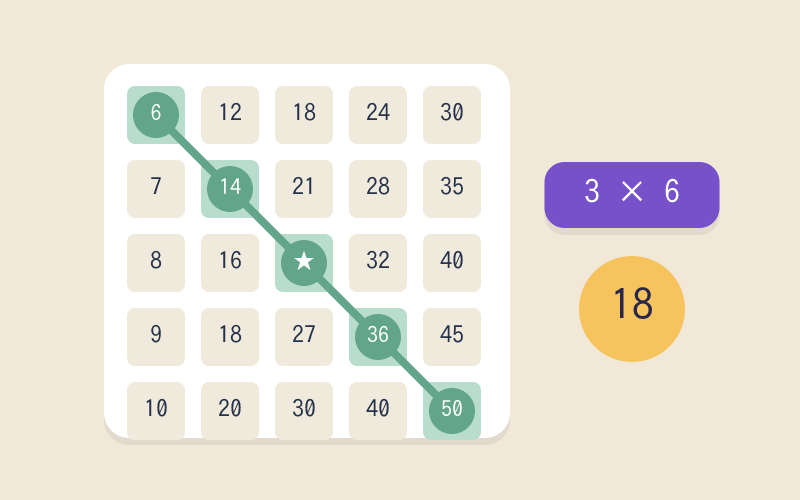
A clue is called in one form—a fraction like 2/48 or a division like 7÷100—and your card shows another. You win a line only when you recognize that 2/48 and 1/24, or 7÷100 and 0.07, are the same number wearing different clothes.
The Caller Says 2/48 — But Your Card Only Shows 1/24
Most drill apps show a fraction and ask you to reduce it, or show a division and ask for the decimal—one form in, one form out. Math Bingo hides the answer inside a different representation. The caller announces 2/48, but your card never prints 2/48; it prints 1/24, and unless you recognize the two as the same value you scan right past the square that would extend your line. The same trap runs with decimals: 7÷100 is called, and only the player who reads it as 0.07 covers the right cell. That leap between forms—a fraction to its simplest name, a division to its hundredths decimal—is where representation fluency either fires instantly or stalls. Racing for five in a row rewards the child who has stopped converting step by step and simply sees that 2/48, 1/24, and 0.07 are names for one number.
One Card, Four Ways to Name a Number: Grades 1–6
In grades 1–2 the mixed card stays gentle: a square reads 12, and the caller might say '7+5' or '3×4', so children match a sum or a product to the same total. By grades 3–4 the forms diverge further—equivalent fractions like 2/48 and 1/24 (3.NF.A.3) and fraction-to-decimal pairs like 7/100 and 0.07 (4.NF.C.6) share a square. Grades 5–6 fold in multi-digit products and decimal arithmetic (4.NBT.B.5). Because every representation on the card points at one value, moving up a grade means adding a new way to recognize a number you already know, not memorizing it again.
Learning Points
- rapid recall
- team rotation
- category review
- explaining answers
Steps and completion rules
- Choose a skill and inspect the answer board; the center is already marked.
- Solve a call, locate the matching answer, and mark it. Advance to another call when ready.
- Complete a row, column, or diagonal. Reduce equivalent fractions and convert division by 100 to decimal form when those modes are selected.
Teacher / Parent Note
For example, 2/48 matches 1/24 and 7 ÷ 100 matches 0.07. Ask for the conversion before marking.