Fraction Addition, Step by Step: Build Each Fraction, Find a Common Denominator, and Add
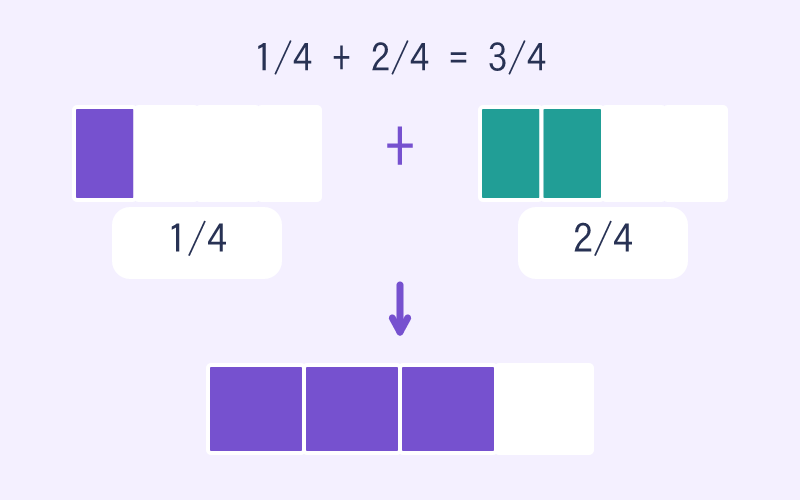
Tap boxes to set each numerator, then slide the bars until both fractions share one denominator before you add and simplify. Each checkpoint asks you to confirm the move yourself, so the reasoning behind adding fractions stays visible.
The Add Step Stays Locked Until You Confirm the Denominators Match
The hardest part of unlike-denominator addition isn't the arithmetic — it's the urge to jump straight to adding and skip the common-denominator step entirely. This game refuses to let that happen: every checkpoint is gated, and the add step stays locked until you have confirmed the two denominators actually match. You move through the sequence in order — build each fraction, decide whether the denominators are the same, convert if they aren't, and only then does adding unlock, followed by simplify. Skipping ahead is not an option the interface offers, so the order of operations turns into muscle memory instead of a rule that evaporates under pressure. Once the steps feel automatic, Hard mode flips you into author mode: you write the word problem, pick the two fractions and the operation, then solve your own — which reveals whether you truly own the sequence or were only following prompts.
From Like to Unlike Denominators: The Grade 4–5 Step Students Skip
This lands on the Grade 4–5 hinge where like-denominator addition (4.NF.B.3) opens into unlike denominators that must first be converted (5.NF.A.1) — and the move students most often drop is exactly that conversion in the middle. Because the add step won't unlock until the common denominator is confirmed, the game holds them at the precise point they'd otherwise rush past. It builds on earlier equivalent-fraction work and feeds forward into fraction subtraction, mixed numbers, and later rational-number arithmetic, where the same skipped step comes back to bite. Gating the sequence, then handing over authorship in Hard mode, is what carries students across that stall.
Three Math Skills Built While Tapping Boxes
- Build each fraction with boxes so the numerator becomes visible Number Sense, not a guessed digit.
- Convert unlike denominators by cutting the bars into equal pieces — the Conceptual Understanding behind equivalent fractions.
- Check every move: add the numerators, keep the denominator, then simplify, growing self-checking Fluency.
From Reading the Problem to Simplifying: One Addition in Seven Moves
- Read the problem, then tap the boxes to build the first and second fraction — the lit boxes are the numerator.
- Decide whether the denominators match; if not, drag the sliders to cut both bars into the same number of parts.
- Add the numerators, keep the denominator, then simplify and confirm the answer.
- Level up: switch to Hard mode to write your own word problem, choose the two fractions and + or −, then solve it step by step.
Five-Minute Routine: Let a Student Build the Wrong Answer First
Project 1/4 + 2/3 and let one student follow the wrong instinct, adding across to 3/7. Then build both fractions with boxes and ask the class which pieces are not the same size. Once they say the boxes do not match, introduce the common denominator. The wrong answer makes the rule stick.
Two Questions Teachers Hear About Adding Fractions
Q: My student keeps adding the denominators too — how does this help?
A: Adding straight across is the classic unlike-denominator error. When the child builds 1/4 and 2/3 with boxes, the mismatched box sizes are obvious, so adding them makes no sense until both are cut to the same size. Because every step must be confirmed, the game surfaces that misconception again and again instead of hiding it behind a rule.
Q: Is this too easy for fluent students?
A: Send them to Hard mode. Instead of solving a problem you give them, the student authors one — write a word problem, pick the two fractions, choose + or −, then solve it with the same boxes, common-denominator sliders, and simplifying. Composing a correct problem is a tougher check of understanding than computing a fluent one.