Fraction Bricks: Add and Subtract Unlike Fractions by Making Every Piece the Same Size
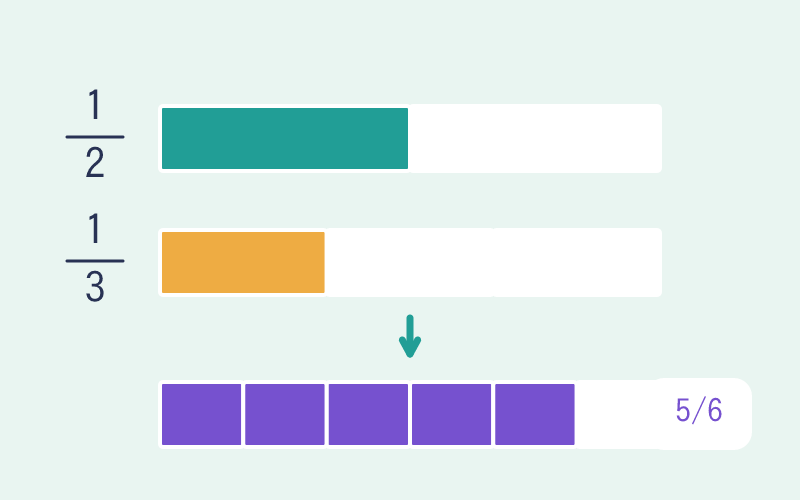
Drag a red bar over a blue one, add glowing cuts until the pieces line up, then count the shaded result. You build the reasoning behind common denominators instead of memorizing a rule.
The Overlap Test: Halves and Thirds Land on Different Cut Lines Until You Slice Both Bars Into Sixths
Set the half-bar directly on top of the third-bar and the first thing you notice is that their cut lines never meet — the single line that splits the red bar into halves falls nowhere near the two lines that split the blue bar into thirds. That misalignment is the whole problem with 1/2 + 1/3: the pieces are different widths, so there is nothing to count yet. Tap the glowing cuts and Fraction Bricks re-slices both bars to the same grid — the halves open into 3/6 and the thirds open into 2/6 — until every line on the red bar sits exactly above a line on the blue bar. Now the widths agree, the bars separate, and counting the shaded sixths gives 5/6. The least common denominator isn't a rule you apply; it's the first grid where both bars finally share every cut line.
Grades 4-6: From Recognizing Equivalent Fractions to Cutting Both Bars Onto One Shared Grid
Fraction Bricks builds on Grade 4 equivalence (4.NF.A.1) and the piece-by-piece decomposition behind like-denominator sums (4.NF.B.3), then puts that reasoning to work on the Grade 5 goal of adding and subtracting fractions with unlike denominators (5.NF.A.1). Because students reach the common denominator by physically cutting both bars onto one shared grid rather than following a written procedure, the model carries forward into later rational-number work, where the same re-slicing logic governs any pair of fractions. Lining the bars up here turns 'find a common denominator' into something a student can see and build.
Three Fraction Skills Practiced With the Bar Model
- Build common denominators from least-common-multiple cuts.
- Translate equivalent fractions such as 1/2 = 3/6 and 1/3 = 2/6.
- Solve fraction addition and subtraction by counting equal-sized pieces.
Three Moves: Overlap, Cut, Count
- Overlap the two fraction bars and compare their partition lines.
- Click glowing cuts until every piece has the same width.
- Separate the model, count the colored pieces, and enter the result.
Five-Minute Teacher Routine: Ask Which Pieces Are Not Equal
Start with 1/2 + 1/3 and pause after the overlap. Ask students to point out which pieces are not the same width. Then use their observation to introduce the least common denominator.
Fraction Bricks Questions Teachers Ask
Q: Why overlap the bars first?
A: The overlap makes mismatched units visible. Students see the reason for common denominators before using the rule.
Q: Does the game accept simplified answers?
A: Yes. Equivalent answers are accepted, so 10/12 and 5/6 both work.
Play and rules
Overlap two fraction bars, add cuts until the pieces have equal widths, and count the result. The common denominator follows from making the parts the same size.
Modes and difficulty
Use addition or subtraction with unlike denominators. The free-input builder at the top lets you model a particular fraction problem.
Practice connections
Before counting, compare the whole bars and the size of one piece. Explain why adding numerators is valid only after both fractions use equal-sized parts.