Fraction Number Line: Plot Fractions Where They Really Belong
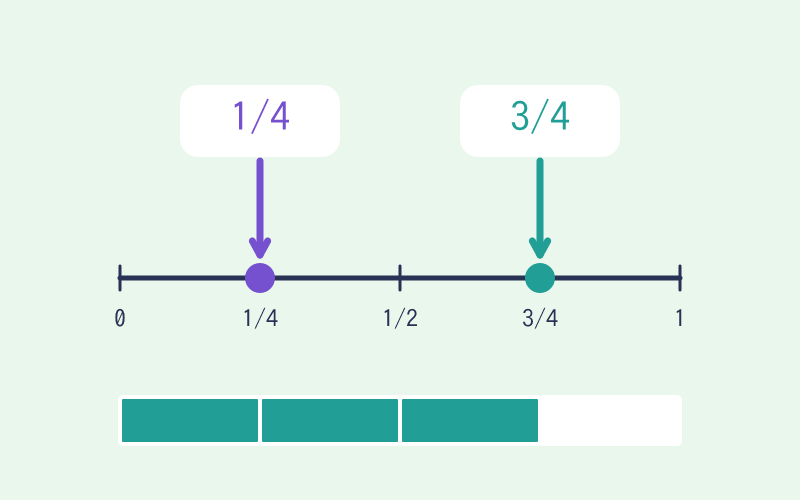
Drag the partition slider to cut the unit into equal parts, then place each fraction at its true point. It trains you to read a fraction as a distance, not just a shape.
Counting Tick Marks Fails: The Denominator Sets How Many Equal Parts
Drop 3/4 onto a bare number line and the reflex is to count to the third tick and stop — no matter how the unit is actually cut. That is the stall this puzzle targets: with no pie to lean on, the marks get read like a plain counting sequence. Here you first drag the partition slider to split the unit interval into the number of equal parts the denominator names, then step the point that many parts along. Watching 2/4 and 1/2 snap to the very same location turns equivalence from a memorized rule into a fact you can point to right on the line. When two fractions carry different denominators, the line forces you to re-partition — the concrete root of why unlike fractions need a common denominator.
From First Equal Shares to Comparing Unlike Fractions, Grade 3 Through 5
This game anchors 3.NF.A.2 — understanding a fraction as a point on the number line — right after students first meet fractions as equal shares. It grows naturally into recognizing equivalent fractions (3.NF.A.3, 4.NF.A.1) and comparing them (4.NF.A.2) once re-partitioning makes common denominators obvious. That same reasoning becomes the foundation for adding and subtracting unlike fractions in Grade 5.
Learning Points
- visual modeling
- step checking
- units and quantity
- applied reasoning
Steps and completion rules
- Read both number-line endpoints before deciding where the fraction belongs.
- Move the slider for placement tasks; choose <, =, or > for comparisons, and matching values for equivalence tasks.
- Finish all six tasks, then revisit errors such as comparing denominators alone or ignoring the scale.
Teacher / Parent Note
Mark one half first and ask which side the target belongs on. Avoid memorizing a slider percentage without understanding the scale.