Mixed Number Addition & Subtraction: Set Up, Build Equal Wholes, and Simplify
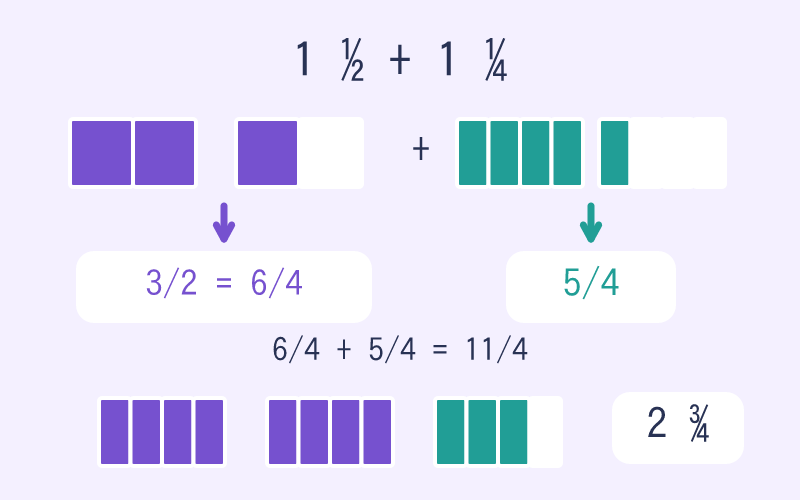
You read the problem, type both quantities and the operation into blank fields, and only advance once your setup checks out. Then you rebuild each mixed number on equal-sized bars and reason about a common denominator before adding or subtracting.
Why the First Step Stays Blank Until You Translate the Sentence
Most step solvers hand students a ready-made expression, so the hardest move — turning a sentence into numbers — never gets practiced. Here the whole-number, numerator, and denominator boxes and the +/− sign all start empty, and a wrong entry keeps you on the reading step instead of flashing the answer. Once your setup is checked, each mixed number is rebuilt on several equal-sized bars, so 1 1/2 visibly becomes one full bar plus a half rather than an abstract 3/2. Sliding the parts onto a common denominator shows why the numerators can only be combined after every slice is the same size. The result is simplified back into a mixed or whole number, and you can revisit any step to see what stayed equal.
From Fourth-Grade Like Denominators to Fifth-Grade Regrouping Across Wholes
This fits Grade 4 students who can already name equivalent fractions and add like-denominator fractions (4.NF.B.3c), giving them mixed-number sums that stay within one denominator. Grade 5 extends the same bars to unlike denominators, where finding a common denominator becomes essential (5.NF.A.1). The skill sits between earlier part-whole and equivalence work (4.NF.A.1) and later multiplication of fractions and rational-number arithmetic.
Five Connections from Reading to the Final Answer
- Set up the expression before calculating: enter both quantities in their original order and check the operation against the problem.
- Convert a mixed number using whole × denominator + numerator, keeping the denominator unchanged.
- Build several equal wholes: the denominator partitions each whole, while the numerator counts parts across all of them.
- Use equivalent fractions to obtain a common denominator, then add or subtract numerators measured in the same unit.
- Check the simplest result, writing a mixed number or whole number and recognizing a result of zero.
Read the Problem, Then Check One Step at a Time
- Choose an example or four-question practice, or enter a clear English or Chinese problem with two quantities or an addition/subtraction expression. Custom problems can start only when the quantities, operation, and supported values are unambiguous; otherwise rewrite the text or choose an example.
- Read the problem and fill the blank whole-number, numerator, and denominator fields yourself, keeping the original order of the two quantities. Choose the addition or subtraction sign. Each quantity must be from 0 to 6, with an input denominator from 1 to 12.
- Check both values and the operation. Incorrect entries stay on this step without revealing the correct expression. When everything is correct, manually choose the next step.
- Convert each mixed number to a fraction using whole × denominator + numerator. Build the quantities with several equal-sized whole models.
- Find a common denominator and write both equivalent fractions. Check that every part has the same size.
- Add or subtract the numerators, keep the denominator, simplify, and write the mixed-number or whole-number result. Check each step before continuing and revisit earlier steps when needed.
- If subtraction would produce a negative result, change the problem or choose another example. The activity preserves the original order of the quantities.
Teaching Prompt: Estimate Before Counting Parts
Start with a ribbon story: there are 1 1/2 meters and another 1 1/4 meters are added. Ask the student to enter the quantities in order and choose the operation before calculating. After that check passes, estimate a result between 2 and 3. Convert to 3/2 + 5/4, rewrite as 6/4 + 5/4, and obtain 11/4 = 2 3/4. Ask what stays unchanged at each conversion, then try subtracting equal quantities to get zero.
Questions About Mixed-Number Practice
Q: Why does 1 1/2 become 3/2?
A: One whole contains two halves. Add the extra half to make three halves, so the numerator is 1 × 2 + 1 = 3 and the denominator stays 2. The model keeps the wholes the same size.
Q: Can the activity automatically solve any word problem?
A: No. A custom problem must clearly establish two quantities and their addition or subtraction, within the supported ranges. Extra quantities, conflicting units, unclear relationships, or out-of-range values prevent it from starting. Rewrite the problem or choose an example. You may also type an explicit two-number expression into the problem box, but the student must still set it up independently in the first step.
Q: Can subtraction produce zero or a negative number?
A: Subtracting equal quantities can produce zero. Negative results are outside this activity: you will be asked to change the problem, and the two quantities will not be silently reversed.
Q: Why are the first fields blank, and what happens if I get them wrong?
A: This step practices reading and setting up the expression. Enter the two quantities in their original order and choose the operation yourself. Incorrect entries remain on this step with a prompt to check again, without the correct expression being shown. After passing, manually move to the next step. To change the problem, rewrite the text or choose another example and complete the reading step again. Earlier completed steps can be revisited.