Fraction Subtraction, Step by Step: Subtract Unlike Denominators One Checkpoint at a Time
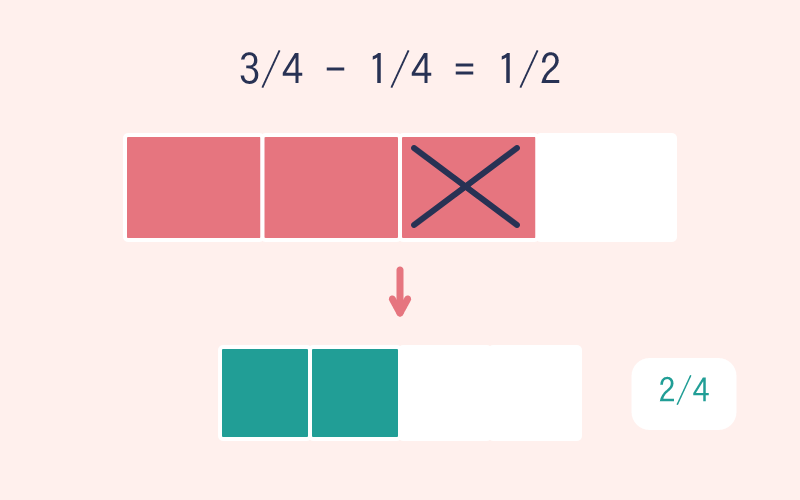
Each round opens with a 'how much juice is left' problem: you tap boxes to build both fractions, drag sliders to a common denominator, subtract, and simplify. Confirming one move at a time turns 'subtract straight across' into a mistake you can actually see.
Why Subtracting Straight Across Falls Apart the Moment the Bars Don't Line Up
Most fourth and fifth graders can knock out 5/8 − 1/8 in their heads, then reach for 5/6 − 1/4 and take top-from-top, bottom-from-bottom out of pure habit. The stall isn't the subtraction — it's failing to notice that two fractions cut into different-sized pieces can't be combined at all. Here you build each fraction by tapping boxes, so 5/6 and 1/4 sit side by side as bars you can plainly see are mismatched. Dragging the sliders re-slices both bars into the same number of parts before the subtraction unlocks, so the common denominator stops being a memorized rule and becomes the thing that makes the pieces line up. Every checkpoint asks you to confirm the move, so the wrong shortcut keeps getting caught in the act.
Where Unlike-Denominator Subtraction Lands in the Grade 4-5 Fraction Arc
This step sits between two skills: reading equivalent fractions and building a bar-model feel for size (3.NF.A.1, 4.NF.A.1) come first, and it feeds directly into finding common denominators for unlike-denominator subtraction (5.NF.A.1) and later rational-number arithmetic. It aligns with CCSS 4.NF.B.3 for like denominators and 5.NF.A.1 for unlike ones, isolating each move so students who already subtract like denominators can carry the same logic over to coprime ones.
Three Skills Students Build Subtracting With Boxes
- Build each fraction from boxes so the numerator is visible Number Sense rather than a guess.
- Convert to a common denominator by cutting the bars equal — the Conceptual Understanding subtraction depends on.
- Check each move: subtract the numerators, keep the denominator, simplify, growing self-checking Fluency.
From Reading to Simplifying: One 'Pour It Out' Subtraction in Seven Moves
- Read the problem, then tap the boxes to build the top and bottom fraction — the lit boxes are the numerator.
- Check whether the denominators match; if not, drag the sliders to cut both bars into the same number of parts.
- Subtract the numerators, keep the denominator, then simplify to find how much is left.
- Level up: switch to Hard mode to write your own word problem, choose the two fractions and + or −, then solve it step by step.
My Five-Minute Routine: Ask for a Prediction First
I open with 5/6 minus 1/4 and ask the class to predict the answer out loud; plenty blurt out something like 4/2. Then I build both fractions with boxes and ask which pieces are not the same size. When they say the boxes do not match, I introduce the common denominator — far stickier than me reciting the rule.
Two Fraction-Subtraction Traps Teachers Watch For
Q: My class subtracts the denominators too — what fixes it?
A: Subtracting straight across is the classic unlike-denominator trap. When a student builds 5/6 and 1/4 with boxes, the box sizes plainly differ, so subtracting them makes no sense until both are cut equal. Because the game confirms every step, the trap keeps surfacing until the common-denominator habit sticks.
Q: Does going step by step slow fluent students down?
A: The early pace is the point — it turns finding a common denominator and simplifying into muscle memory. Once a student moves smoothly through the 'how much juice is left' levels, Hard mode (writing their own problem) is where the time goes into composing rather than computing, because they no longer hesitate over whether to find a common denominator first.