Dice Bingo: Roll Two Dice, Add the Sum, and Fill a Line Before Anyone Else
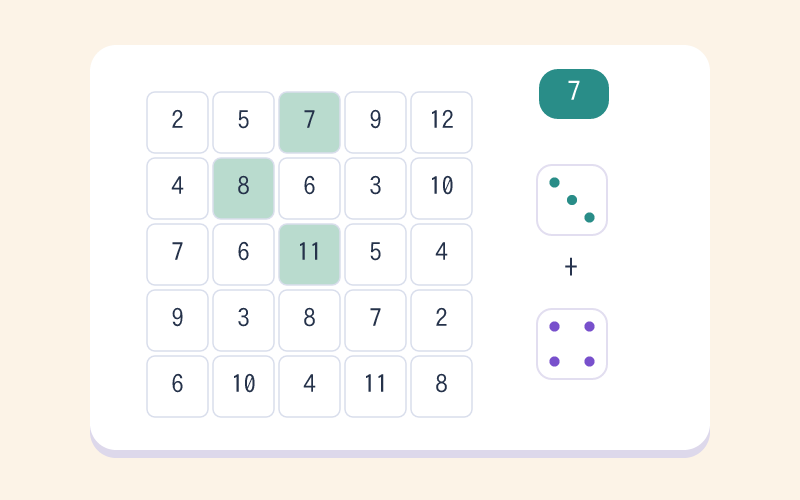
Each turn you add the pips on two dice and tap a matching cell on the 5x5 grid. Racing to complete a row, column, or diagonal trains fast addition and a feel for which sums actually keep showing up.
A 5x5 Grid Looks Fair, but Seven Comes Knocking Far More Than Two
Seven has six ways to land on two dice while two has only one, yet the totals from 2 to 12 sit in a tidy row that tempts you to treat them as equally likely. This game breaks that assumption: because the board repeats high-frequency totals, the cells for 6, 7, and 8 fill up while the corners holding 2 and 12 stay empty roll after roll. Watching your marks pile toward the middle makes the uneven sample space visible without a single formula. You start to infer which dice pairs stand behind each total, then choose the open cell that gives your line the best chance.
One Board, Two Jobs: Quick Sums for Third Graders, Odds for Sixth
Third and fourth graders sharpen rapid addition of two numbers (3.NBT.A.2) while the board quietly shows that outcomes are not equally likely. Fifth and sixth graders list the sample space of dice pairs and compare how often each sum lands, previewing formal probability models (7.SP.C.7, 7.SP.C.8). Counting the pairs behind each total is the bridge from arithmetic fluency to reasoning about distributions in middle school.
Core Skills Practiced in Dice Bingo
- rapid addition of two values
- the sample space of two-dice sums
- choosing a mark with probability in mind
Start in Three Steps
- Roll two dice and calculate the sum.
- Mark one open cell with that value.
- Complete a row, column, or diagonal.
Teacher and Parent Note
After play, count how often 2, 7, and 12 appeared. List the dice pairs for each sum to explain why middle totals are more common.