Risk Dice: Decide When to Bank Before a Single 1 Wipes the Column
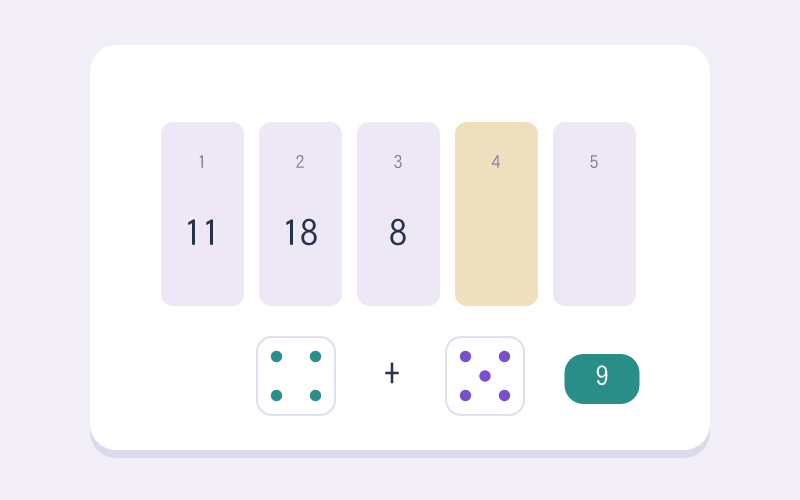
Roll two dice down each of five columns, watching the sum or product stack up, then tap Bank before a rolled 1 erases everything. Each choice trains you to weigh a growing reward against a fixed probability of losing it all.
The Odds of Rolling a 1 Never Change — But the Stakes Do
Most players treat every roll as equally safe, since two dice show a 1 about a third of the time no matter how high the column climbs. What shifts is the amount that single 1 can destroy: banking 4 points feels the same as banking 22, yet the second gamble puts far more on the line. Because ZogMath shows the column total ticking upward in real time, that lengthening bar makes the invisible expected loss visible. Students begin to reason about the moment when one more roll is no longer worth a fixed one-in-three chance of losing everything. Switching between sum-risk and product-risk mode sharpens the point, since products climb faster and punish greed sooner.
Banking a Column Links Grade 3 Mental Sums to Grade 7 Odds: Building Probability Intuition and Expected-Value Reasoning
Younger players lean on fast mental sums and products with two dice, extending the fluency work of 3.OA.C.7, while older students formalize the pattern into likelihood on the 0-to-1 scale of 7.SP.C.5. Recording how often a 1 appears turns repeated play into experimental probability under 7.SP.C.6, and comparing sum-risk to product-risk decisions previews expected-value reasoning in 7.SP.C.7. The game bridges arithmetic fluency to genuine risk analysis without a single formula.
Core Skills Practiced in Risk Dice
- mental sums and products with two dice
- comparing the risk of rolling versus stopping
- building probability intuition from repeated outcomes
Start in Three Steps
- Choose sum-risk or product-risk mode.
- Roll to build the column or bank when the risk feels too high.
- Finish five columns and compare the safe total.
Teacher and Parent Note
Record how many points students had when they chose to continue and what happened. Discuss the score level where their decisions became more cautious.