Probability Experiment Lab: Test Whether Real Trials Match Your Predictions
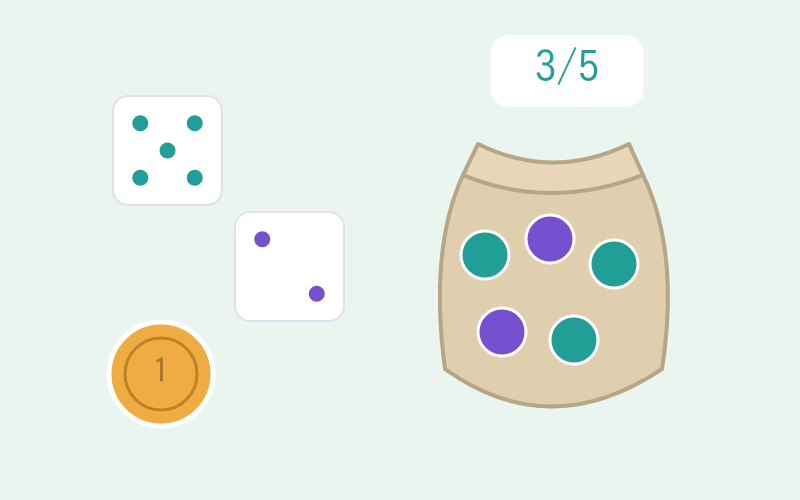
Flip coins, roll dice, and draw colored balls, logging each result as a running tally and bar. As the trial count climbs, you watch the experimental frequency drift toward the theoretical probability you calculated.
A Fair Coin Can Land Heads Six Times: Why Small Samples Lie
Students use systematic counting to see a coin is 1/2 heads, then feel cheated when ten flips give seven heads and decide the coin is broken or that tails is finally due. This lab makes the gap visible: each tap adds one trial to a live tally, so a jagged early graph smooths as hundreds of trials pile up. Drawing from a bag of 3 red and 1 blue balls teaches the same point, the observed ratio swings wildly at 10 draws and settles near 3:1 by 200. Watching the frequency line converge, instead of being handed a rule, is what separates the theory was wrong from my sample was too small.
Bridging Grade 5 Fraction Sense to Grade 7 Reasoning About Chance
This lab bridges Grade 5 fraction sense (writing 1/2 or 1/6 for a single outcome) into the Grade 7 probability standards, where students compare theoretical and experimental probability and use long-run frequency to estimate chance (7.SP.C.5, 7.SP.C.6, 7.SP.C.7). It builds on listing a sample space by systematic counting and prepares students for compound-event probability and simulation design (7.SP.C.8).
Learning Points
- data collection
- graph representation
- measures of center
- theoretical and experimental probability
Steps and completion rules
- Choose the coin or die event and explain why its theoretical probability is one half.
- Use +1 or +10 to observe how the measured frequency changes with the sample.
- Finish after at least twenty trials or continue comparing results. Switching experiments clears the trial record.
Teacher / Parent Note
Compare two experiments with the same sample size. Different observed frequencies do not change the die event’s theoretical probability.