Long Division Workshop: Work Through Every Divide-Multiply-Subtract Step
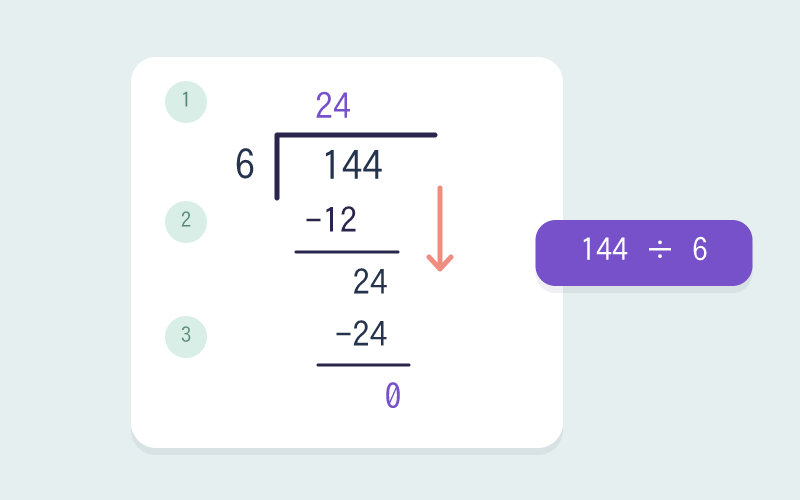
Drag each quotient digit above the correct place, then watch the multiply-and-subtract cycle play out beneath it. You build the whole algorithm one column at a time, so the reasoning behind every step stays visible instead of hidden in memorized rules.
The Quotient Digit Has an Address: Column Placement Decides Everything
Seven fits into 43 six times—that part comes quickly; the real slip is deciding which column that 6 belongs above, and whether a place that won't divide needs a zero placeholder. The Workshop pins each quotient digit to a labeled column, so a misplaced answer visibly floats over the wrong place and refuses to lock in. When you multiply and subtract, the partial product drops directly under the digits it came from, turning 'bring down the next digit' into a physical pull rather than an abstract rule. Miss a zero and the columns stop lining up, giving instant feedback that a place was skipped. By the end, the algorithm reads as a sequence of column decisions, not a chant to memorize.
From Multiplication Facts to Dividing Four-Digit Numbers by Hand
This workshop assumes students already own their multiplication facts and place-value naming, then extends them into dividing four-digit numbers by one-digit divisors (4.NBT.B.6) and by two-digit divisors (5.NBT.B.6). Working the columns by hand builds toward fluent multi-digit division with the standard algorithm (6.NS.B.2), the last stop before dividing decimals and reducing fractions. Students who master the divide-multiply-subtract-bring-down loop here carry it straight into long division of decimals and rational-number arithmetic.
Learning Points
- visual modeling
- step checking
- units and quantity
- applied reasoning
Steps and completion rules
- Use the current partial dividend to find and enter the next quotient digit.
- Multiply by the divisor, enter the difference, and bring down the next digit when prompted.
- Enter the complete quotient and move to the next problem. Finish all three to see the result.
Teacher / Parent Note
For 735 ÷ 5 = 147, ask why each remainder must be smaller than 5 before bringing down another digit.