Sum 31 Grid: Trade Cards Until Every Row and Column Hits 31
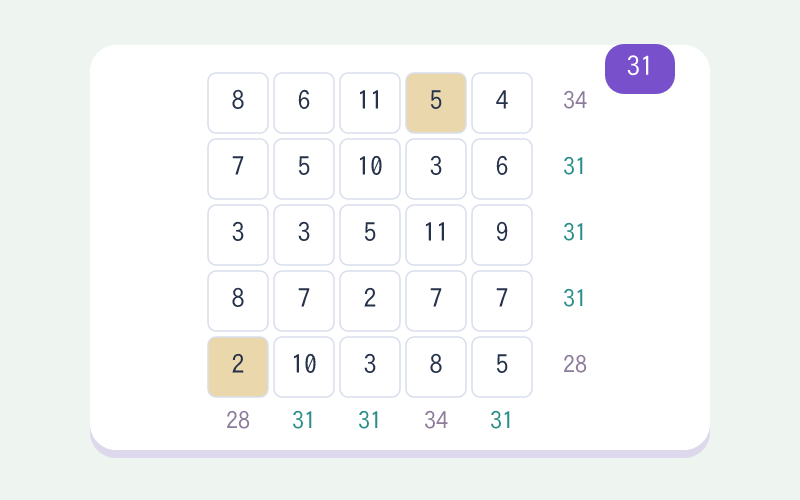
You swap two number cards at a time and watch all ten totals update live. Each move trains you to read the whole board, not just the line you just touched.
Students Who Fix One Row Forget Each Card Also Belongs to a Column
Most students patch a single row to 31, feel done, and then notice three columns have drifted out of range. That trap comes from forgetting that every one of the 25 cards is shared by one row and one column, which means a single swap quietly edits two totals. Because the board recalculates all ten sums the instant you exchange two cards, you can watch a repair in one line ripple straight into another. The winning habit is to hunt for two lines with opposite gaps — one two over, one two under — and move a card that transfers exactly that difference. Aces count as 11 here, so a single high card can swing a line further than beginners expect.
Multi-Step Addition Grows Into Constraint Reasoning (Grades 5-8)
The grid rewards fast, accurate addition of five values, the fluency fifth graders carry forward from earlier place-value work (4.NBT.B.4). Testing whether a swap keeps a line at 31 is the same substitution reasoning behind checking solutions to equations (6.EE.B.5), and searching for the structure that links two lines builds the pattern sense named in MP.7. That bridge from arithmetic fluency to systematic constraint solving is exactly what readies middle schoolers for algebraic thinking.
Core Skills Practiced in Sum 31 Grid
- adding five values accurately
- tracking one card across two constraints
- using sum differences to choose a swap
Start in Three Steps
- Inspect the current five row and five column totals.
- Select two cards to exchange positions.
- Bring all ten lines to 31 at the same time.
Teacher and Parent Note
Look for opposite differences first, such as one line two high and another two low, then search for a swap that transfers that difference.