Sum Line Push: Fire Tiles Into Lines That Total 12
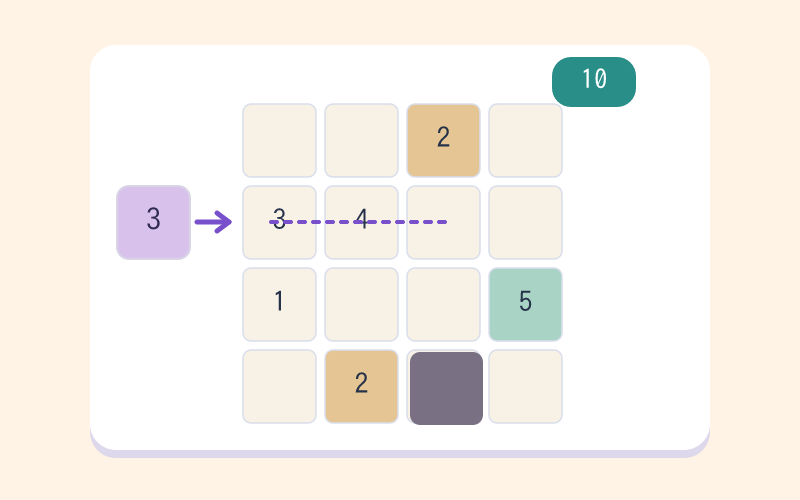
Tap an arrow on any side of the 4×4 board and the next number slides to the first open cell in that direction. You are hunting for a row or column of at least three tiles that adds up to exactly 12, so every shot is a small deduction about space and sum.
The Arrow Decides the Cell, Not You: Plan the Side Before the Sum
Most players fire a tile wherever the total looks close, then wonder why it landed two squares from the gap they meant to fill. The catch is that each arrow drops the tile into the first empty cell it meets, and placed tiles never shift afterward, so the side you pick, not the number itself, controls the destination. Before tapping, trace the path the tile will travel and picture the exact cell it will occupy. Then check whether that cell nudges a line of three-plus tiles toward 12 without overshooting. Naming the landing square out loud turns a lucky guess into a rule you can reuse.
Reasoned Addition Meets Spatial Planning Across Grades 3 to 6
Third and fourth graders arrive able to add within 20 and spot simple arithmetic patterns (3.OA.D.9), and this puzzle stretches that into choosing among placements to reach a fixed target. Fifth and sixth graders use the same board to generate and test rules about which side works (4.OA.C.5), rehearsing the make-use-of-structure habit that later powers combining terms and mental arithmetic (MP.7).
Learning Points
- spatial transformation
- multi-step planning
- working memory
- strategy review
Steps and completion rules
- Read the next tile and calculate how much a candidate row or column still needs to reach 12.
- Choose an arrow that inserts the tile into the intended first empty cell.
- Complete a row or column with at least three occupied cells totaling 12.
Teacher / Parent Note
Identify the destination cell before predicting the sum; the arrows insert a tile rather than shift an entire row.