Matrix Cross Sum: Fill Every Empty Cell From Its Row and Column Totals
Generate fresh 3×3 or 4×4 values and row/column sums.
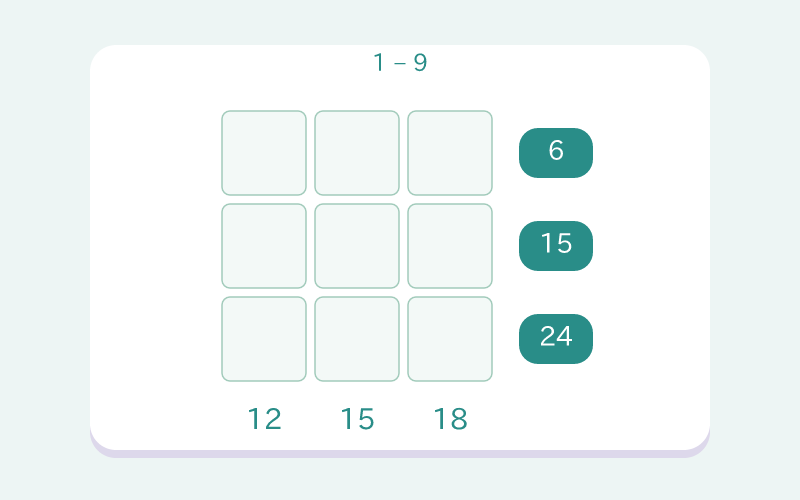
| Name | Matrix Cross Sum |
|---|---|
| Catalog grade suggestions | Grade 4, Grade 5, Grade 6 |
| Actual task | Empty grid — fill numbers so every row and column matches the sum clue |
| Practice objective | Practice the following task: Empty grid — fill numbers so every row and column matches the sum clue |
| Optional curriculum references | CCSS.MATH.CONTENT.4.OA.A.3 (Common Core State Standards); CCSS.MATH.CONTENT.4.NBT.B.4 (Common Core State Standards); CCSS.MATH.CONTENT.6.EE.B.5 (Common Core State Standards) |
Grades are catalog suggestions. Curriculum entries are references, not certification. Choose a practice length that fits your session.
A Blank Grid Gives You No Starting Number, So the Cell You Commit First Forces All the Rest
Generate fresh 3×3 or 4×4 values and row/column sums. Any legal arrangement meeting the public sums is accepted; hints respect current entries and New set changes targets.
From Filling One Blank to Constructing a Whole Grid That Balances Both Ways (Grades 4-6)
Matrix Cross Sum starts from the missing-addend and multi-digit addition fourth graders already practice (4.OA.A.3, 4.NBT.B.4), where a single unknown part is recovered from a known total. Here there is no half-finished line to lean on: students construct several values at once so an entirely blank array balances down every column and across every row. Committing one cell and watching the targets force the others is a first taste of testing a value against an equation to see whether the whole system holds (6.EE.B.5)—exactly the move Grades 5 and 6 need before formal algebra.
Three Skills Practiced in Matrix Cross Sum
- finding missing addends from target totals
- treating row and column clues as connected equations
- cross-checking a value in two directions
Teacher and Parent Note
Start with the row or column containing the most known information. After entering a value, require the student to check both its row and column rather than finishing only one direction.