Triangle Cross Sum: Fill the Sides So Every Edge Shares One Total
Generate fresh triangle numbers and locked clues, then use the remaining pool to meet all three side targets.
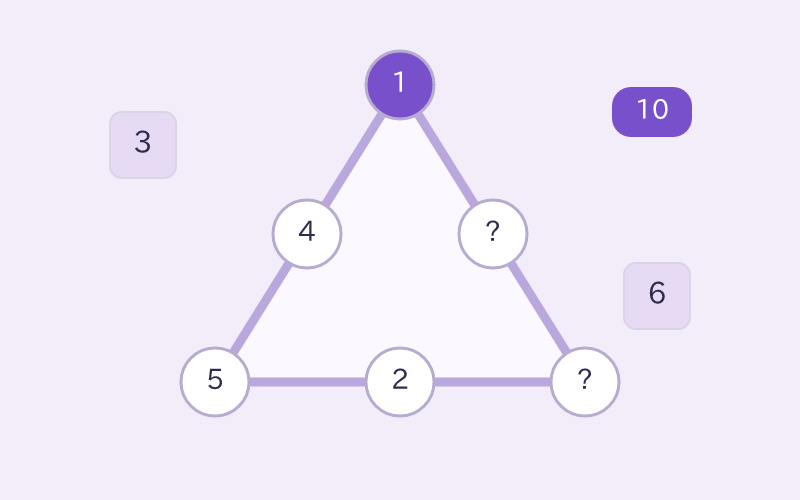
| Name | Triangle Cross Sum |
|---|---|
| Catalog grade suggestions | Grade 4, Grade 5, Grade 6 |
| Actual task | Some slots pre-locked — place the rest so all three triangle sides share the same sum |
| Practice objective | Practice the following task: Some slots pre-locked — place the rest so all three triangle sides share the same sum |
| Optional curriculum references | CCSS.MATH.CONTENT.4.OA.A.3 (Common Core State Standards); CCSS.MATH.CONTENT.4.NBT.B.4 (Common Core State Standards); CCSS.MATH.CONTENT.6.EE.B.7 (Common Core State Standards) |
Grades are catalog suggestions. Curriculum entries are references, not certification. Choose a practice length that fits your session.
Read the Locked Corners First — They Already Fix Each Edge's Gap
Generate fresh triangle numbers and locked clues, then use the remaining pool to meet all three side targets. Hints find a completion consistent with current entries; New set changes data and clues.
Grades 4–6: When a Locked Corner Turns an Unknown Into Plain Subtraction
This puzzle sits between the multi-digit fluency of Grade 4 and the equation reasoning of Grade 6. Adding and subtracting whole numbers and recovering a missing addend (4.NBT.B.4, 4.OA.A.3) is the everyday skill, but the locked corners raise the stakes: once a target total and the fixed values are set, an open edge is not a slot to explore — it is a single number you subtract your way to. That is exactly the move behind 6.EE.B.7, where a constrained unknown has one value that makes the equation true. Reasoning from locked slots back to each forced edge is a concrete bridge from arithmetic facts to early algebraic thinking.
Three Skills Practiced in Triangle Cross Sum
- target sums on three connected sides
- finding missing addends from known totals
- eliminating positions with shared-node constraints
Teacher and Parent Note
Have the student write how much each side still needs before moving a value. For every placement, ask them to explain why it works for both sides touching that position.