Kakuro Sum Grid: Deduce the Digits That Make Every Run Add Up
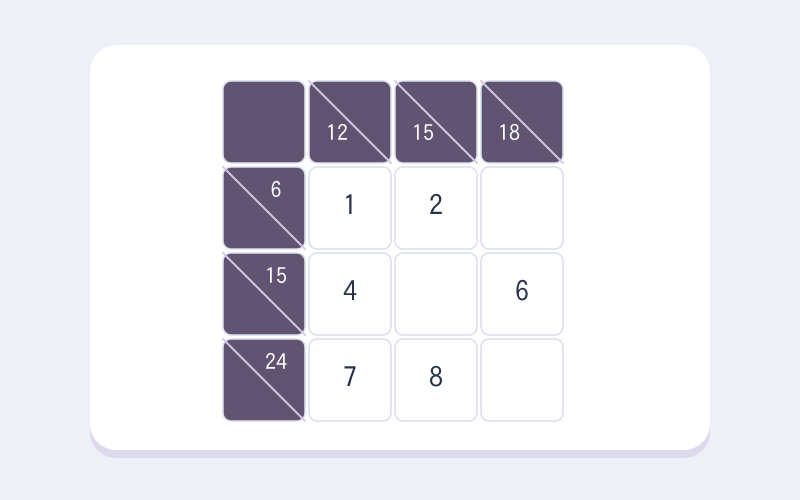
Tap a white cell and enter 1–9, or drop candidates into Notes while you weigh combinations. Each board trains you to reason from sums and structure instead of guessing.
A Correct Combination Still Leaves the Order Open — the Crossing Run Decides Which Cell Takes Which Digit
Most solvers can list that a two-cell run of 4 is 1+3, yet freeze on which cell holds the 1. That gap — a correct combination but an undetermined order — is where Kakuro thinking lives. Here you park both options in the Notes overlay, then let the crossing down-run eliminate one: if that column's total rules out a 3, the cell resolves on its own. Watching a candidate vanish the moment a crossing sum contradicts it turns 'combinations' from a memorized list into a visible act of deduction. The diagonal clue cells keep both totals on screen so you can test an assumption against two constraints at once.
From Addition Fluency to Combinatorial Reasoning Across Grades 5–8
Kakuro leans on the addition-and-decomposition fluency built in earlier grades (MP.7 structure over 4.OA.A.3 multi-step reasoning), then pushes it toward the pattern analysis of 5.OA.B.3 as students track how a partial sum limits what a run can still become. A 5x5 board keeps runs short for the transition; the 9x9 topology demands holding several crossing constraints at once, the same working-memory load that later supports algebraic systems. The next step is expressing those distinct-digit, fixed-total constraints symbolically in 6.EE.A.2 expressions.
Four Math Skills Practiced in Kakuro
- decompose a target into distinct digits from 1–9
- use partial sums to test whether a run can still finish
- intersect across and down candidates at one cell
- preserve multi-step eliminations with candidate notes
Four Steps to Complete a Kakuro
- Read the across and down totals in each diagonal clue cell.
- List distinct-digit combinations that can reach the target.
- Cross-check both runs at a white cell and record uncertain values as notes.
- Use Check to review entries and continue until every run reaches its sum.
Teacher and Parent Note
Begin with one two-cell run and ask for every distinct combination, then use a crossing run to determine order. The goal is not speed alone; ask why a combination has become impossible.
Play and rules
Place digits 1–9 in white cells so each across and down run reaches its diagonal clue sum. Digits cannot repeat within a run. Notes record candidate combinations, and Check reviews the current entries.
Modes and difficulty
Daily mode keeps the same puzzle for the date; Practice offers another. The 5×5, 7×7, and 9×9 boards add more crossing runs, giving each digit more relationships to satisfy.
Practice connections
For a two-cell sum of 4, the digits must be 1 and 3. Use the crossing run to determine their order, then verify both sums after placing a value.