Arithmetic Cages: Deduce Every Number From Its Cage Clues
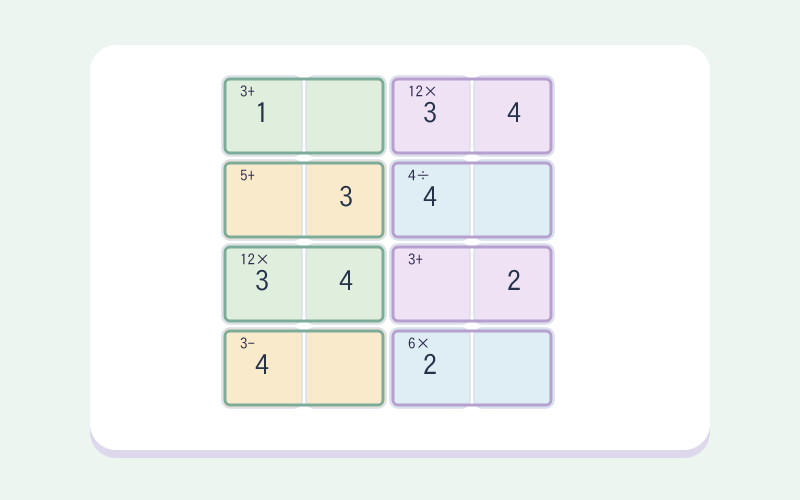
Tap a cell, cycle candidates, and watch cage targets confirm or reject each guess. Every placement trains you to hold a Latin-square rule and an arithmetic target in mind at once.
A Product of 12 Is Not One Answer: The Column Decides Which Factor Pair
A cage marked ×12 will take 2 and 6 or 3 and 4 without complaint, yet the moment the column above already shows a 6, only one of those pairs can survive. A cage target rarely fixes its numbers alone; the no-repeat rule down the column throws most factor pairs out. In Arithmetic Cages you tap through candidates and the grid instantly flags a repeat, so an impossible pair is crossed off before you commit. That feedback loop turns the abstract try-test-retract logic into something visible, making the pull between a cage and its lines concrete.
Turning Times-Table Recall Into Constraint Reasoning, Grades 4-7
Fourth graders bring factor-pair fluency (4.OA.B.4) plus the multi-step interpretation named in 4.OA.A.3 to small four-cell cages. As grids grow, sixth and seventh graders reason about which values satisfy a target the way they test solutions to an equation (6.EE.B.5), a direct bridge toward variables and systems. The game links known times-table facts to the deductive habit those later topics demand.
Learning Points
- logical elimination
- candidate tracking
- row and column constraints
- pattern validation
Steps and completion rules
- Read the target and operation in each cage and inspect the fixed digits.
- Select an empty cell and enter 1–4 with the keypad; use clear to revise an entry.
- Combine row-column elimination with cage arithmetic until every constraint is satisfied.
Teacher / Parent Note
Do not treat every cage as addition. Ask learners to name its operation before listing possible combinations.