Mini Sudoku: Deduce Every Digit With Row, Column, and Box Logic
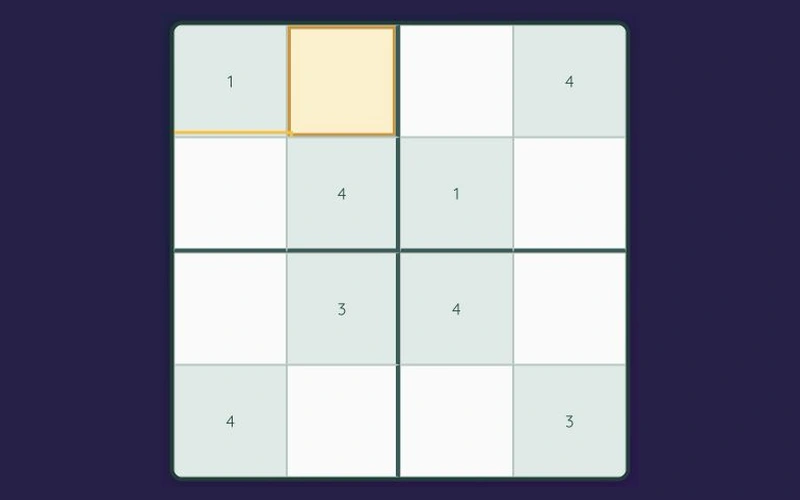
Pick an empty square, then narrow it to the one digit its row, column, and box will all allow. Each move trains you to eliminate candidates and prove a single answer instead of guessing.
One Constraint Is Never Enough: The Cell Is Fixed Only Where Three Rules Agree
Beginners often scan a single row, spot two open cells, and guess between them. A digit only locks when the row, the column, and the box all forbid every other option at the same time. In this grid you tap a square and see which numbers each direction has already ruled out, so the overlap of three constraints becomes visible instead of imagined. That turns 'it might be 3' into 'it must be 3 because nothing else survives.' Working small 4x4 and 6x6 boards keeps the whole web of clues in view while that habit forms.
Latin-Square Logic That Carries 2nd-6th Graders Toward Algebraic Thinking
On the 4x4 board younger solvers practice one-to-one placement and the idea that a group must hold each symbol exactly once, extending earlier counting and sorting work (MP.7, look for structure). The 6x6 board scales that same no-repeat-in-a-group logic to overlapping regions, the reasoning that later underpins ratio tables and equations. Justifying each placement aloud builds the argue-from-evidence habit of MP.3, and untangling a stuck grid rehearses the persistence named in MP.1.
Learning Points
- logical elimination
- candidate tracking
- row and column constraints
- pattern validation
Steps and completion rules
- Choose a board size and start with a row, column, or box containing useful givens.
- Select an empty cell and use the keypad, or turn on candidate mode to record possibilities.
- Resolve row-column-box repetitions and fill the board. Use clear when an entry or note needs revision.
Teacher / Parent Note
Ask which candidates were eliminated before each definite placement, and distinguish a note from a committed answer.