Killer Sudoku: Break Every Cage Sum Into Digits That Still Fit the Grid
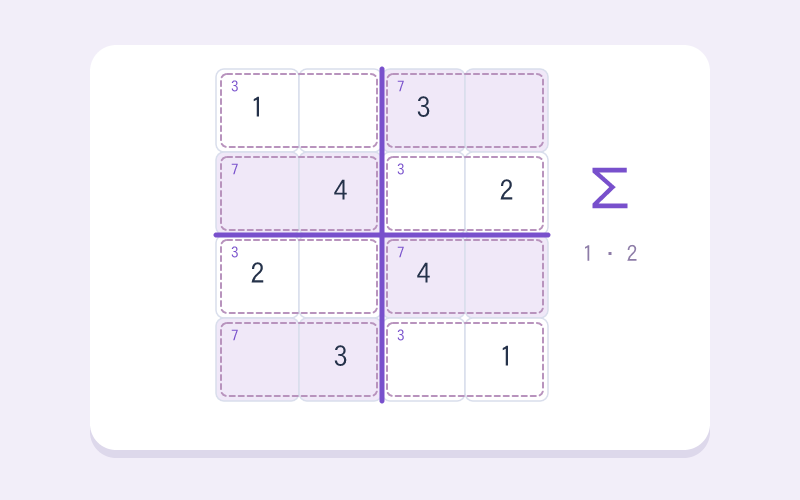
Split each dashed cage's target into non-repeating digits, then place them so every row, column, and bold box stays unique. It trains you to hold an arithmetic constraint and a Sudoku constraint in mind at the same moment.
Locking a Cage Sum Too Early, Then Colliding With the Column
Most students lock in the first digit combination that hits a cage's target, then discover it collides with a number already sitting in that row or box. This game keeps both pressures visible at once: the dashed cage shows its sum while the highlighted row, column, and bold box show what is already taken. In Notes mode you can pencil every valid combination for a two- or three-cell cage, then watch options vanish as neighboring cells fill. Because one target can split many ways, the real move is to infer which split survives all three Sudoku constraints, not just the addition. The Check button confirms an entry without solving it for you, so the deduction stays yours.
Cage Arithmetic Matures Into Multi-Constraint Deduction, Grades 3–8
On the 4x4 board, students decompose sums within 10 into distinct addends, extending the add-subtract fluency of 3.OA.C.7. The 6x6 and 9x9 boards fold that arithmetic into the pattern analysis behind 5.OA.B.3 and 4.OA.C.5, where one rule generates and constrains every later choice. The next step is chaining several conditional deductions at once — informal groundwork for the variable reasoning of 6.EE.
Four Math Skills Practiced in Killer Sudoku
- decompose a target sum into distinct digit combinations
- cross-check row, column, and box eliminations
- compare candidates and keep a visible reasoning record
- move between a local cage and whole-grid constraints
Four Steps to Solve a Killer Sudoku
- Start with a small target, a single cell, or a cage with only a few possible combinations.
- Use Notes mode to record candidates without committing an answer.
- After every entry, check its cage sum plus the row, column, and bold box.
- Use Check to review current entries, then continue until every constraint is satisfied.
Teacher and Parent Note
Do not begin with a full combination chart. Ask students to list every distinct combination for one two- or three-cell cage, then eliminate choices using a shared row, column, or box. After solving, have the student explain one cage where a local sum unlocked the wider grid.
Play and rules
Choose a 4×4, 6×6, or 9×9 board. Use cage targets together with row, column, and box constraints. Record possible digits with Notes, then use Check to review entries that may need another look.
Modes and difficulty
Daily mode keeps the same puzzle for the date. Practice offers another puzzle. Larger boards add longer cages and more candidates to consider; start with a small cage whose sum has only a few possible combinations.
Practice connections
When a candidate fits a cage sum, still check its row, column, and box. Explain which crossing constraint ruled out an alternative before placing the final digit.