Futoshiki Inequality: Place Digits So Rows, Columns, and Signs Agree
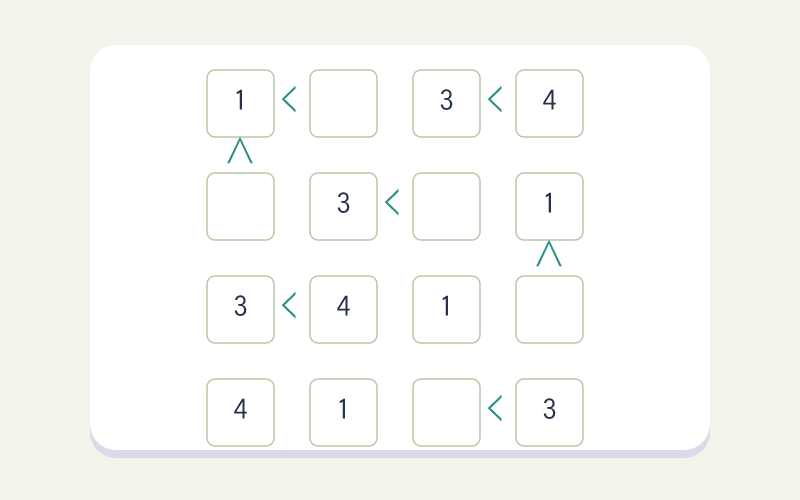
Pick any open cell, key in a digit the keypad allows, and red conflict flags light up the instant a repeat or a broken sign appears. Each board trains you to hold Latin-square uniqueness and a chain of inequalities in mind at once.
Trace the Chain of Signs Before Locking In a Digit Your Row Allows
Most players drop in a digit the instant it makes a row or column unique, then stall when a nearby > sign quietly rules it out. The trap is treating the Latin-square rule and the inequalities as two separate puzzles instead of one board. Here the < and > marks sit right on the grid lines between neighbors, so sweeping your eye along three cells reveals an ordered chain — and the cell at the tall end of that chain simply cannot hold the smallest value. Enter a digit and instant red flags expose the clash you missed, so an abstract ordering argument becomes a visible mistake you can correct on the spot. After a few boards you stop guessing and start eliminating.
Reading Inequality Symbols as Ordered Reasoning, Grades 4 to 7
Students arriving from grade 4 pattern work (4.OA.C.5) already read growing sequences, and Futoshiki asks them to enforce order across two directions at once. The < and > constraints preview grade 6 inequality notation (6.EE.B.8) and the ordering of values on a number line (6.NS.C.7), so the deductions here scaffold the algebraic inequalities students meet in grade 7. Each solved board rehearses justifying a placement instead of accepting a lucky guess.
Learning Points
- logical elimination
- candidate tracking
- row and column constraints
- pattern validation
Steps and completion rules
- Read the direction of each inequality and inspect the row and column givens.
- Select an empty cell and enter an allowed value, clearing it when you need to revise.
- Satisfy every inequality and all row-column uniqueness constraints before the board is complete.
Teacher / Parent Note
Read consecutive inequalities as an ordered chain, then identify positions that cannot contain the smallest or largest value.