Shape Patterns: Read the Repeating Unit and Fill Every Missing Slot
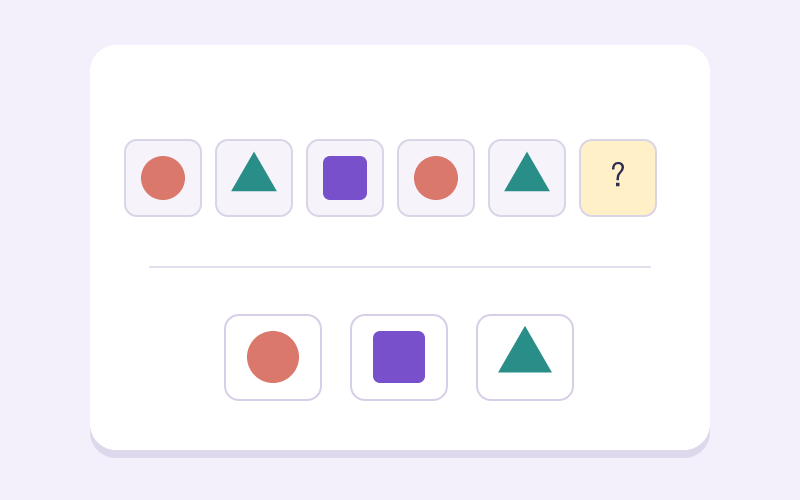
You scan a row of shapes, isolate the smallest chunk that repeats, then tap the choice that keeps the rhythm going. The game trains kids to turn a vague "that looks right" into a rule they can state out loud.
Copying the Last Shape Fails: The Unit Is a Chunk, Not One Picture
A circle-square-triangle row runs across the screen with one slot blanked out mid-sequence, and the quick move is to copy whichever picture sat just before the gap — so the repeat collapses into "another triangle." That echo is the stall: the pattern gets read as loose single shapes instead of one bundle that repeats as a whole. The answer choices here deliberately include the echo-the-neighbor trap, forcing students to test a full unit before they tap. When they slide their eyes across two complete cycles first, the chunk becomes visible and the missing shape stops being a coin flip. Saying the unit aloud — circle, square, triangle, circle, square, triangle — is what turns the picture into a rule they can defend.
From Sorting Shapes to Stating a Rule: The Grade 2-3 Leap
Grade 2 students arrive able to sort and classify shapes by attribute (2.G.A.1), and this game converts that recognition into cyclic prediction. Come Grade 3, the same repeating-unit thinking underpins the addition-table pattern work of standard 3.OA.D.9, where learners explain the regularities hiding in a sums grid. The visual-to-rule bridge built here is exactly what later number sequences and function tables (4.OA.C.5) will demand.
Three Pattern Skills Practiced While Filling the Missing Shape
- Identify the repeating unit in a visual sequence.
- Predict the missing or next shape.
- Explain why the selected shape continues the pattern.
Three Moves to Complete the Pattern: Look, Unit, Choose
- Look across the visible shape sequence.
- Find the smallest repeating unit.
- Choose the missing shape that continues the unit.
Five-Minute Teacher Routine: Turn Choices Into Pattern Language
Build a quick pattern with blocks or stickers before play. Once students create a repeat themselves, they usually recognize it faster on screen.
Shape Patterns Questions Teachers Ask About Guessing
Q: Why does my student choose by feel?
A: Ask them to name the repeating unit, such as red-blue-red-blue, before choosing.
Q: How is this math?
A: It builds pattern recognition and prediction, the same thinking used in number patterns and sequences.