Ice Array: Trace a Fixed-Step Path Across the Ice
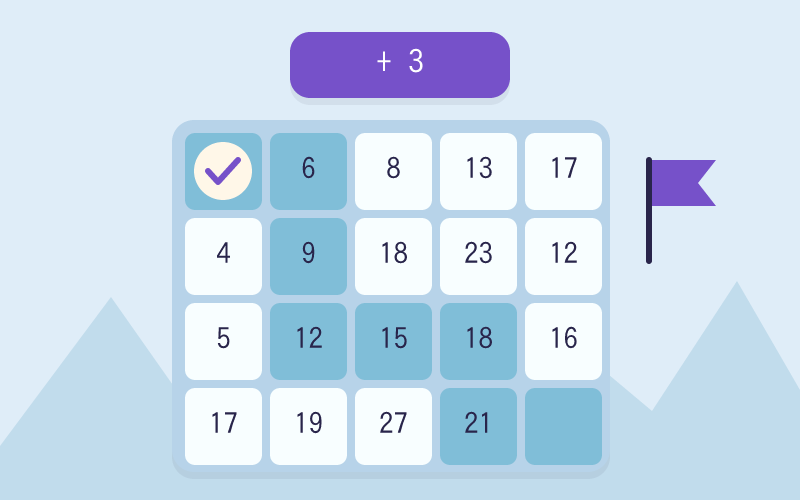
Read the fixed step, then tap the ice tiles that keep the same increase all the way across the grid. Each move trains you to hold an arithmetic rule instead of solving one number at a time.
Track the Fixed Step Through Every Fork, Not the Tile That Sits Closest
Most fifth graders can extend a sequence written on one tidy line, but the ice grid scatters candidate tiles and slips in numbers that sit close to the right answer. The stall shows up the moment a student stops saying 'previous number plus the step' and starts guessing by proximity. Because each tile you tap either continues the increase or dead-ends on the ice, the abstract rule turns into a physical route you can watch failing. Restating '+3, +3, +3' before each step becomes the fix, not an afterthought. The path makes rule-keeping visible in a way a worksheet row never does.
Grades 5-6: Growing Pattern Fluency Before Formal Function Tables
Ice Array sits right after students first analyze patterns and relationships in 5.OA.B.3, asking them to carry a constant difference across many positions rather than one. That habit is the direct on-ramp to writing and graphing the rule as a variable relationship in 6.EE.C.9. Students who lock in 'same step every move' here are ready to name the pattern with an expression next.
Three Sequence Skills Practiced While Crossing Ice Tiles
- Identify the fixed step in an arithmetic sequence.
- Extend an increasing pattern across several positions.
- Reject nearby distractors that do not match the rule.
Three Moves to Cross the Ice: Read, Predict, Step
- Read the fixed step, such as +3.
- Check whether nearby ice tiles continue the increasing sequence.
- Step along the matching path and restate the rule after any miss.
Five-Minute Teacher Routine: Turn the Ice Path Into a Step Rule
Before the path starts, ask students how much the sequence changes each step. Naming the rule first usually improves their route choices right away.
Ice Array Questions Teachers Ask About Pattern Carryover
Q: Why can my student find the next number but miss the path?
A: The path adds distractors. Ask them to say the previous number plus the step before moving.
Q: Is this middle-school sequence work?
A: This is a foundation version focused on fixed changes and rule keeping before formal function tables.