Sequence Discovery: Uncover the Hidden Rule and Fill Every Missing Term
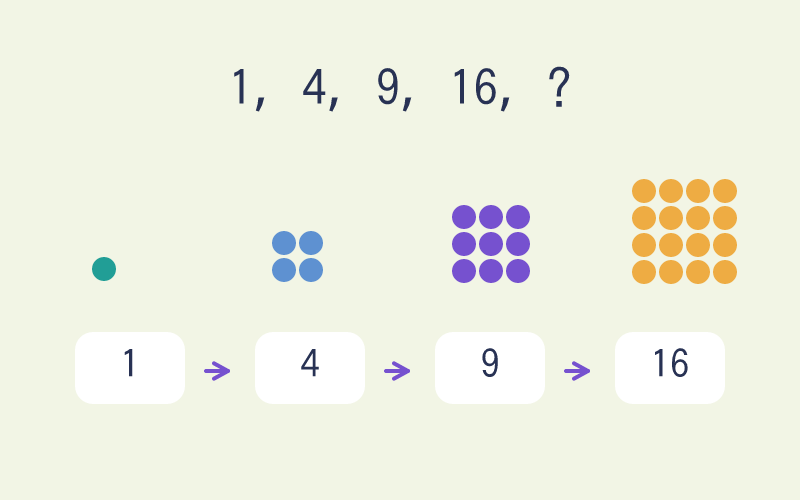
You slide along a numbered sequence track, weigh the rule-card options, and drop in the one term that fits. Every round trains you to test a structure instead of guessing after a single glance.
The Gap Between Terms Is Also a Sequence
The usual instinct is to subtract each pair of neighbors and expect one steady gap, which collapses the moment the differences themselves grow, double, or fold into a Fibonacci sum. Sequence Discovery makes that hidden layer visible: the numbered track lets you line up not only adjacent terms but skipped terms and positions, so a second row of differences appears on the very screen you are reasoning over. When you open a rule card, the game forces that rule to explain every visible term before it accepts your next-term entry, and working the Fibonacci, square, and doubling cards one at a time turns the round into casework you can feel rather than a single lucky guess. This is where the abstract idea that the pattern of the changes is itself a pattern turns into something a fourth grader can point at.
Difference Tables Bridge Grade 4 Sequence-Building Toward Grade 5 Two-Pattern Comparison
It links the Grade 4 skill of generating and describing a numeric sequence (4.OA.C.5) to the Grade 5 move of comparing two related sequences by their position numbers (5.OA.B.3). Students who already own constant add-on sequences stretch here into recursion, perfect squares, and difference tables, the structures that later underwrite arithmetic-series sums and olympiad pattern problems.
Three Pattern Skills Practiced While Finding the Next Term
- Inspect the sequence track by comparing adjacent terms, skipped terms, and positions.
- Identify the rule card: Fibonacci-style, square, doubling difference, or grouped cycle.
- Predict the missing term and verify it against the surrounding terms.
Three Moves to Discover: Track, Rule, Term
- Read the sequence track from left to right and locate the blank.
- Compare differences, sums of previous terms, square numbers, or group changes.
- Use the rule card to test whether the pattern explains every visible term.
- Enter the missing number and verify it with the neighboring terms.
Five-Minute Teacher Routine: Name Possible Rules Before Solving
Ask students what possible pattern types they notice before solving. Naming the options helps them approach advanced sequences more systematically.
Sequence Discovery Questions Teachers Hear
Q: Why does my student guess on advanced sequences?
A: They may only know how to check first differences. Ask whether the pattern could involve changing differences, squares, recursion, or groups.
Q: When should students use the hint?
A: After naming at least two possible pattern types. The rule card should confirm an observation, not replace it.