Arithmetic Series: Pair the Ends and Sum a Long Run of Terms Fast
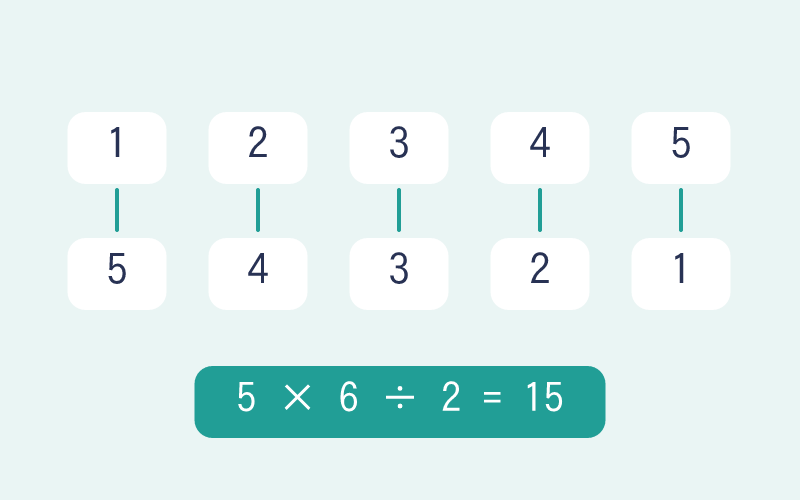
Read an arithmetic track, tag the common difference, then fold the first term onto the last to build equal-sum pairs. You practice turning slow term-by-term addition into a structural shortcut you can actually justify.
Memorizing (first + last) × n ÷ 2 Hides Why the Ends Pair Up
Plenty of kids can recite the sum formula long before they trust it, so they freeze the moment a series has an odd number of terms or starts at something other than 1. This game puts the common-difference tag on the track first, so a learner sees the fixed step before hunting for a total. When you drag the first term to meet the last, the two values snap into a pair with the same sum, and the next pair inward shows it again — the equal-sum idea stops being a claim and becomes visible on the track. Tallying how many pairs you actually made turns the ÷2 into systematic counting rather than a memorized digit. By the time the formula appears, it reads as a description of what your hands already did.
From Extending a Sequence to Stating an nth-Term Rule
It builds on the pattern-and-rule work of 5.OA.B.3, where students extend a sequence and describe its relationship, and pushes toward the symbolic expressions of 6.EE.A.2 by asking for the nth term rather than the next one. The end-pairing shortcut also seeds the algebraic sum reasoning students formalize later, connecting a concrete count of pairs to a general variable expression (6.EE.B.6).
Three Sequence Skills Practiced in Arithmetic Series
- Identify the common-difference tag as the fixed change between terms.
- Locate first term, last term, and number of terms for nth-term or sum questions.
- Use end-pairing so first and last terms make equal sums.
Three Moves to Sum: Difference, Terms, Pairing
- Inspect the arithmetic track and confirm the common difference.
- Find the first term, last term, and number of terms, or compute the nth term.
- For sums, pair the first and last terms and check that each pair has the same total.
- Choose the answer and compare direct addition with formula-based reasoning.
Five-Minute Teacher Routine: Pair First, Formula Second
Show students how the first and last terms pair before using the formula. Once the pairing is visible, the sum rule is much easier to understand.
Arithmetic Series Questions Teachers Hear
Q: Why can a student recite the formula but not use it?
A: They may not have matched first term, last term, and number of terms to the problem. Label those values before substituting.
Q: Why does the sum of the first n odd numbers equal n squared?
A: It can be seen as a growing square pattern or derived from the arithmetic-series sum formula.