3D Nets Lab: Match Each Solid to the Net That Folds Back Into It
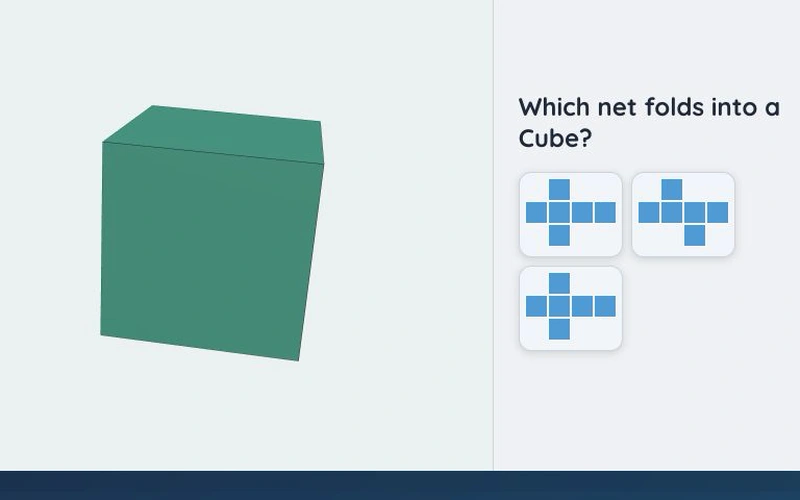
Rotate a cube, prism, or pyramid, then choose which of three flat patterns folds up to rebuild it. Each round trains the mental folding that links 2D faces to 3D form.
Six Squares Don't Make a Cube: Where the Faces Sit Decides the Fold
Most students learn to count faces first, so they assume any pattern with six squares folds into a cube, and any layout with two triangles and three rectangles must be a prism. The real trap is arrangement: a net only closes if each face borders the right neighbor, and an off-by-one square leaves a gap or an overlap. Because you can rotate the solid before deciding, you see which faces actually meet along an edge, then test that adjacency against each flat candidate. Choosing across a cube, a prism, and a pyramid forces the same reasoning on three different edge counts, so the rule generalizes instead of memorizing one picture.
Where Naming Faces Grows Into Folding for Surface Area (Grades 4–6)
The lab builds on classifying 2D shapes and identifying the faces, edges, and vertices of solids (4.G.A.2, 5.G.B.4), turning that vocabulary into spatial action. Recognizing which net folds into a given solid is the exact bridge to representing three-dimensional figures with nets and using them to compute surface area (6.G.A.4). Students who master the adjacency rule here move into surface-area problems without re-learning what a net is.
Learning Points
- spatial transformation
- multi-step planning
- working memory
- strategy review
Steps and completion rules
- Rotate the model to inspect its faces and edges from different angles.
- Compare the base shapes and side-face arrangement in the offered nets, then choose a match.
- Complete the three solids and explain how one chosen net folds back into its model.
Teacher / Parent Note
Sketch an offered net and label neighboring faces. This activity practices selecting a match; it does not offer a free-form net editor.