Rocket Angles: Read the Vertex Ray and Name Its Degree Measure
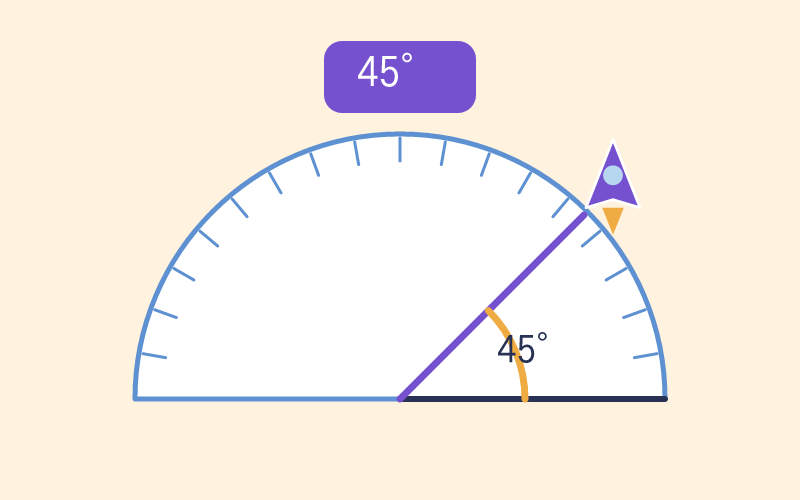
Each round draws an angle with a vertex, a baseline, and a tilted rocket ray; you decide how far it has turned and tap the matching degree. It trains the habit of anchoring at the vertex before you commit to a reading.
Which Side Is Zero? Where 60 and 120 Degrees Trade Places
The classic stumble here is not the number — it is the direction. A student who grabs the protractor's outer numbers reads a 60-degree opening as 120 because they never decided which ray sits on the zero line. Rocket Angles strips away the cluttered double scale of a physical protractor and leaves only the vertex, the baseline, and the rocket ray, so the one decision that matters — how far has this ray swung — stays in the foreground. Before tapping, you commit to acute or obtuse, and the four close-degree options punish a reversed guess. After a few rounds the vertex-first routine becomes automatic.
From “Angles as Rotation” to Confident Protractor Measuring in Grade 4–5
Reading a rocket ray as 45, 90, or 135 degrees turns the idea of an angle as a fraction of a full turn (CCSS 4.MD.C.5) into the hands-on reading practice behind measuring with a protractor (CCSS 4.MD.C.6). Those locked-in benchmark angles then feed the additive angle work of CCSS 4.MD.C.7 and the coordinate and figure reasoning that follows in Grade 5.
Three Measurement Skills Practiced While Reading Rocket Angles
- Locate the vertex and baseline before reading the angle.
- Recognize benchmark degrees such as 45, 90, and 135.
- Choose the correct measure from nearby options while avoiding reversed readings.
Three Moves to Read the Angle: Vertex, Ray, Degree
- Find the vertex and horizontal baseline first.
- Look at how far the rocket ray rotates from the baseline.
- Compare the angle with benchmark degrees.
- Choose the degree option and use feedback to catch reversed readings.
Five-Minute Teacher Routine: Name Vertex and Baseline First
Before each answer, have students say where the vertex is and which ray is the 0-degree side. That habit prevents most reversed readings.
Rocket Angles Questions Teachers Hear
Q: Why does my student confuse 60 and 120 degrees?
A: They may not first decide whether the angle is acute or obtuse. Ask whether the angle is less than or greater than 90 before choosing.
Q: Can this work without a physical protractor?
A: Yes for reading and benchmark practice. Pair it with a real protractor later for center-and-scale alignment.