Tangram Shape Builder: Cover Every Silhouette with Seven Pieces
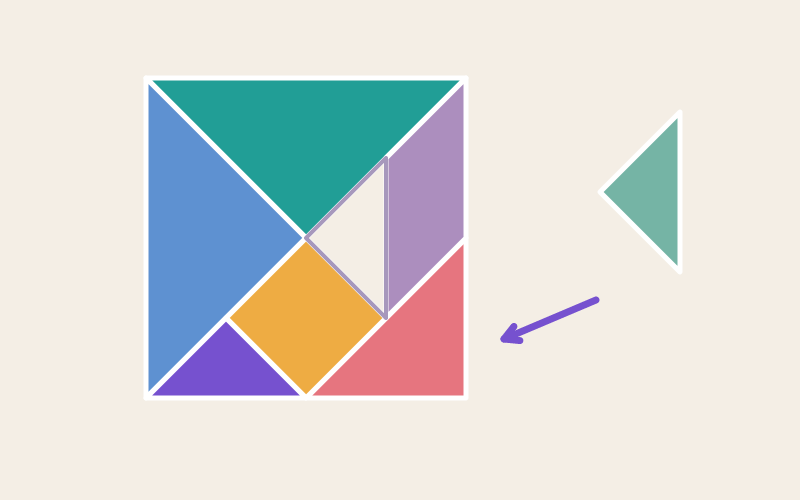
Drag, rotate, and flip seven classic tangram pieces until they cover the target outline exactly. Each puzzle trains you to see how the same shapes combine, decomposing one silhouette into triangles, a square, and a parallelogram.
The Parallelogram Won't Fit Until You Flip It: Rotation Isn't Reflection
Students often assume any orientation can be reached by spinning a piece, so they rotate the parallelogram endlessly and it still overhangs the outline. Tangram Shape Builder splits the two moves apart: the rotate button steps in 45° increments while a separate flip mirrors the piece, exposing that the parallelogram is chiral and its mirror image is a genuinely different pose. Because equal-sized triangles may swap targets, learners also discover that a covered region depends on shape and size, not color. The live piece status tells them whether placement or orientation is the missing step, turning a vague "it doesn't fit" into one specific transformation to test.
From Naming Shapes to Rigid Motions: A Grades 1–6 Geometry Arc
Early players build on naming and joining shapes (1.G.A.2) as they assemble a silhouette from smaller polygons. The rotate-and-flip mechanic previews the rigid motions—translation, rotation, and reflection—that formalize under later geometry standards (4.G.A.3, 8.G.A.1), while swapping equal triangles foreshadows area conservation and shape composition (3.G.A.2, 6.G.A.1).
Learning Points
- spatial transformation
- multi-step planning
- working memory
- strategy review
Steps and completion rules
- Select a piece and compare its status, size, and orientation with the target.
- Drag it near a matching position, tap a compatible target, or choose Move to outline. Rotate by 45° or flip when needed.
- Use the completed-piece count and placement/orientation feedback, then choose Next piece. Two pieces with the same shape and size may exchange targets.
- At 7/7 the completion dialog opens automatically. Choose Next puzzle for another silhouette or Replay this puzzle to practice the current shape again. After the final puzzle, the sequence returns to the beginning.
Teacher / Parent Note
Ask students to predict whether a piece needs translation, rotation, or reflection before moving it. Swap two equal-sized triangles and discuss why the colors change while the covered shape stays the same, then compare a parallelogram with its reflection.