Sum Blocks: Place Every Block So Each Row Lands on Its Target Sum
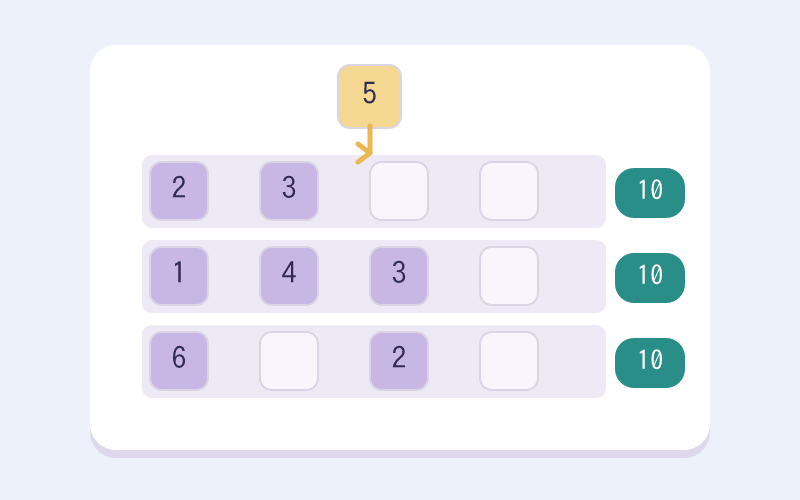
Drag numbered blocks into a grid where each row carries its own target total. Every drop forces you to add what a row already holds and work out the exact amount it still needs.
One Block Can Fit Two Rows — But the Wrong Choice Strands the Numbers Left in Your Hand
A block showing 7 can complete a row that needs exactly 7 or edge a row still short by 10 closer to its goal—and the instant it drops, the row you skipped has to find that total somewhere else. Adding one row up to its goal is the easy part; the stall comes when a value fits several rows at once and every choice reshapes what comes next. Sum Blocks keeps the target and the running total side by side on the grid, so the 'how much is missing' question is visible instead of abstract. As you slide a block down, you watch a row inch toward its target sum and catch the moment it would overshoot. Because a greedy early placement can leave a later block with no legal row, the game trains arithmetic and forward planning inside the very same move.
Row Targets Turn Repeated Addition into Missing-Addend Reasoning, Grades 3-5
The within-100 addition fluency of Grade 2 (2.OA.B.2) becomes the launchpad here, stretching into the multi-digit, multi-step arithmetic named by 4.NBT.B.4 alongside the standard-algorithm rounding of 3.NBT.A.2. Every placement is a missing-addend equation—target minus current sum—the same unknown-in-any-position reasoning that powers 3.OA.D.8 word problems. That groundwork feeds the estimation and multi-step logic students lean on before algebraic equations arrive.
Three Skills Practiced in Sum Blocks
- repeated addition and target sums
- finding a missing addend from a current total
- reserving useful spaces for later blocks
Teacher and Parent Note
Before each placement, ask the student to say how much the row still needs. When two positions are possible, have them compare which row will be easier to complete with the remaining values.